
Hospitality English
Free course ~90 min · 6 modulesLinkedIn-ready certificate

Hospitality English

The English you actually use on shift — free to learn.

Hotels don't need IELTS scores. They need a receptionist who can handle an overbooking at 11pm, explain a bill dispute without escalating it, and give clear directions to a guest who speaks four words of English. This course teaches the specific English that comes up in real hotel and restaurant shifts - not textbook phrases, but the sentences you actually reach for under pressure.

Who it's for
Seasonal and hospitality workers whose first language is not English: hotel staff, waiters, bartenders, resort and event staff, receptionists.

At a glance

Course
Free, online, self-paced
Certificate
€7.99, paid only after you pass
Exam
20 questions, 75% to pass, free retakes
Verification
Unique certificate ID, publicly checkable at hospitalitycertificate.com/verify
Study time
About 90 minutes, 6 modules
Issued by
Hospitality Certificate (CertHub network)

Module 4 of 6

Service Recovery and De-escalation

The S.T.A.R. de-escalation framework, overbooked arrival management, and professional constructive refusals.

What actually works when a guest is angry

When guests complain, they want two things: to be believed, and to not have to fight for a solution.

Tap to continue

Most standard scripts fail both. Here is what each common phrase actually signals to the guest:

'I'm sorry you feel that way' — a non-apology that blames the guest's emotions, not the hotel's failure. 'I understand your frustration' — so overused it reads as a script. Guests have heard it hundreds of times. 'Calm down' — tells the guest their reaction is the problem, not the situation. It reliably escalates things. 'There's nothing I can do' — ends the conversation. 'That's our policy' — a wall. Guests hear: 'I don't care about your situation.'

1/5

The S.T.A.R. framework

S

Stop & Listen

Put down the keyboard. Face the guest. No interruptions until they finish. Use 'I see' and 'go on' to show you are present.

T

Thank & Validate

Not 'I understand your frustration' — say 'Thank you for telling me directly. I want to make this right.'

A

Act with Two Options

Offer two concrete choices with specific timelines. Never 'let me see what I can do' — name exactly what you will do.

R

Recover

Call the room 20 minutes later to confirm the issue is resolved. One follow-up call turns a complaint into loyalty.

Receptionist listens attentively to a concerned guest in a quiet corner away from a queue.
Phrases to keepClick audio icon to listen

“Thank you for telling me directly — I want to make this right.”

Validating guest feedback immediately without defensiveness or debate

“I am sorry that our room fell short of your expectations tonight. Let me see how we can make this right.”

Sincere professional apology focused on active resolution

“I have two options for you right now: [option A] or [option B]. Which would work better for you?”

Empowering an upset guest with two concrete choices and timelines

“I am taking personal ownership of this. Here is exactly what I am going to do.”

Establishing personal accountability to rebuild immediate guest trust

“I'll call your room in 20 minutes to confirm this has been resolved.”

Committing to an explicit service recovery follow-up deadline

“Please tell me exactly what happened so I can correct it immediately.”

Inviting full explanation while signaling immediate remedial action

A complaint that does not calm down at once

Most complaints settle after a sincere apology and a fix. Some do not. This example shows how to stay steady.

Tap to continue

Guest: This is the second time I've called about the air conditioning. Nobody has come. Receptionist: I'm sorry, that shouldn't have happened. Let me check what was logged. [Checks.] I can see your first call at 9 tonight. I'm calling maintenance now, while you're on the line. Guest: I don't want to wait on the line, I want it fixed. Receptionist: Of course. I'll call you back within ten minutes with a confirmed time, and if it can't be fixed tonight I'll offer you another room.

What she did: she did not defend the earlier delay or blame a colleague. She checked the facts, acted while the guest was still talking, and gave a specific call-back time she could keep, plus a fallback.

1/6

The overbooking conversation

The guest has a confirmed prepaid reservation. You have no room for them. They are exhausted.

Tap to continue

The only version of this conversation that works leads with the solution — before explaining the problem.

Never open with 'Unfortunately...' Never say 'The booking engine oversold us' or 'It's not my fault.' The guest does not care about your property management system. They care about where they are sleeping tonight.

1/5
Phrases to keepClick audio icon to listen

“Mr. [name], we have a confirmed room for you at [partner hotel] — it's an upgraded room, fully covered by us for tonight. Transport is ready at the front.”

Leading directly with the complete resolution on an overbooked arrival

“We have a situation I want to address immediately. We have arranged a guaranteed room of [type] at [partner hotel], which is a five-minute walk, same standard, with breakfast included. We have covered all costs.”

Transparent, proactive delivery when relocating a guest

“I understand this is not what you expected tonight. The arrangement is complete — [partner hotel] is expecting you, and our transport will take you there directly.”

Acknowledging disruption while reassuring that all logistics are fully settled

When you cannot say yes
A no without an alternative is a bad no.

Tap to continue

The structure that works: acknowledge what they wanted → honest single-sentence reason → best available alternative → let them respond.

Never say: 'I can't do that.' 'That's impossible.' 'You should have called ahead.'

1/5
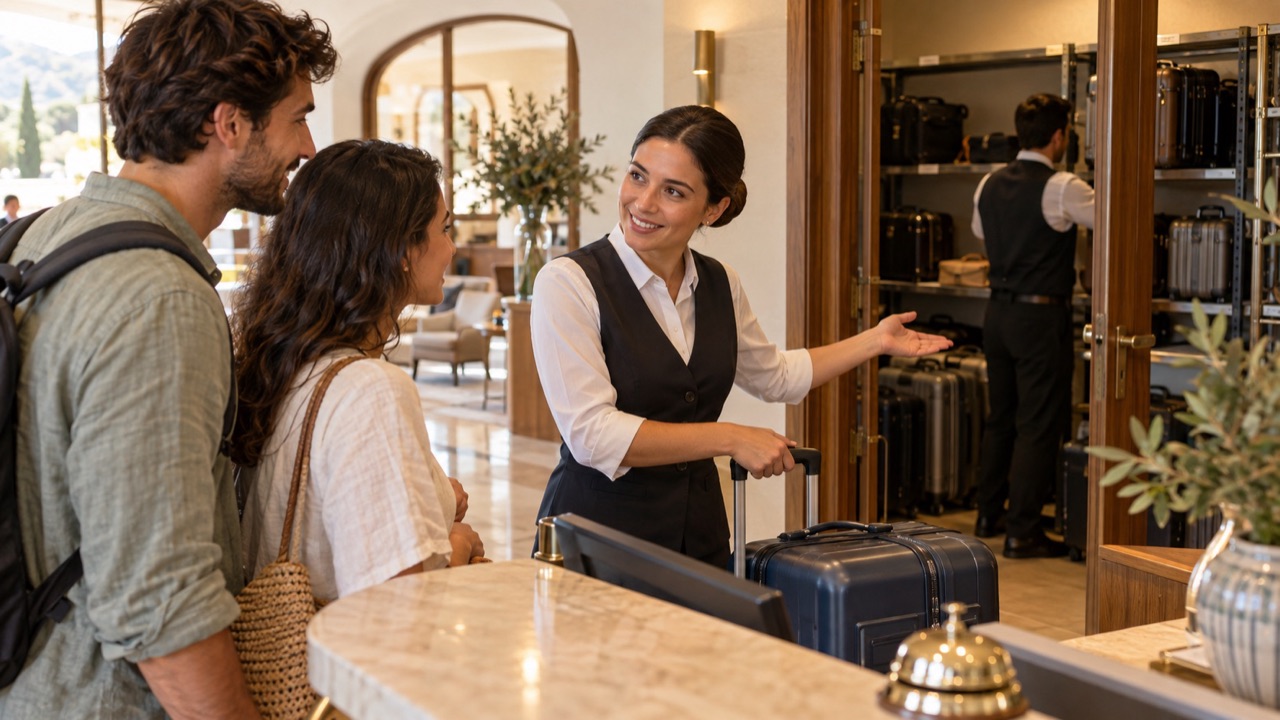
Receptionist offers early-arrival guests a safe attended luggage storage area while the guest room is being prepared.
Phrases to keepClick audio icon to listen

“I'm afraid that's not something I'm able to offer today — [brief honest reason]. What I can do is [best available alternative].”

Standard professional refusal structured with an alternative

“Your room is being prepared by our housekeeping team. It will be ready at 3:00 PM. In the meantime, our luggage room is available and you're welcome to the café and pool.”

Transforming early arrival wait into a welcoming guest experience

“For today specifically, late checkout isn't available — we have a full arrival day ahead. What I can offer is luggage storage until [time], so you can continue to use the hotel facilities.”

Explaining late checkout unavailability while offering facility access

Quick Shift Check

What should you do the moment a guest arrives, even if you're in the middle of another task?

Already know this material?

You can take the 20-question exam any time — no need to finish every module first.

Take the exam
Hospitality English
Free Course & Verified Exam
Take Exam