
Hospitality English
Free course ~90 min · 6 modulesLinkedIn-ready certificate

Hospitality English

The English you actually use on shift — free to learn.

Hotels don't need IELTS scores. They need a receptionist who can handle an overbooking at 11pm, explain a bill dispute without escalating it, and give clear directions to a guest who speaks four words of English. This course teaches the specific English that comes up in real hotel and restaurant shifts - not textbook phrases, but the sentences you actually reach for under pressure.

Who it's for
Seasonal and hospitality workers whose first language is not English: hotel staff, waiters, bartenders, resort and event staff, receptionists.

At a glance

Course
Free, online, self-paced
Certificate
€7.99, paid only after you pass
Exam
20 questions, 75% to pass, free retakes
Verification
Unique certificate ID, publicly checkable at hospitalitycertificate.com/verify
Study time
About 90 minutes, 6 modules
Issued by
Hospitality Certificate (CertHub network)

Module 2 of 6

Front-Desk Financials

Pre-authorization holds, incidental deposits, municipal tourist taxes, and discreet card decline recovery.

Pre-authorization holds and incidentals
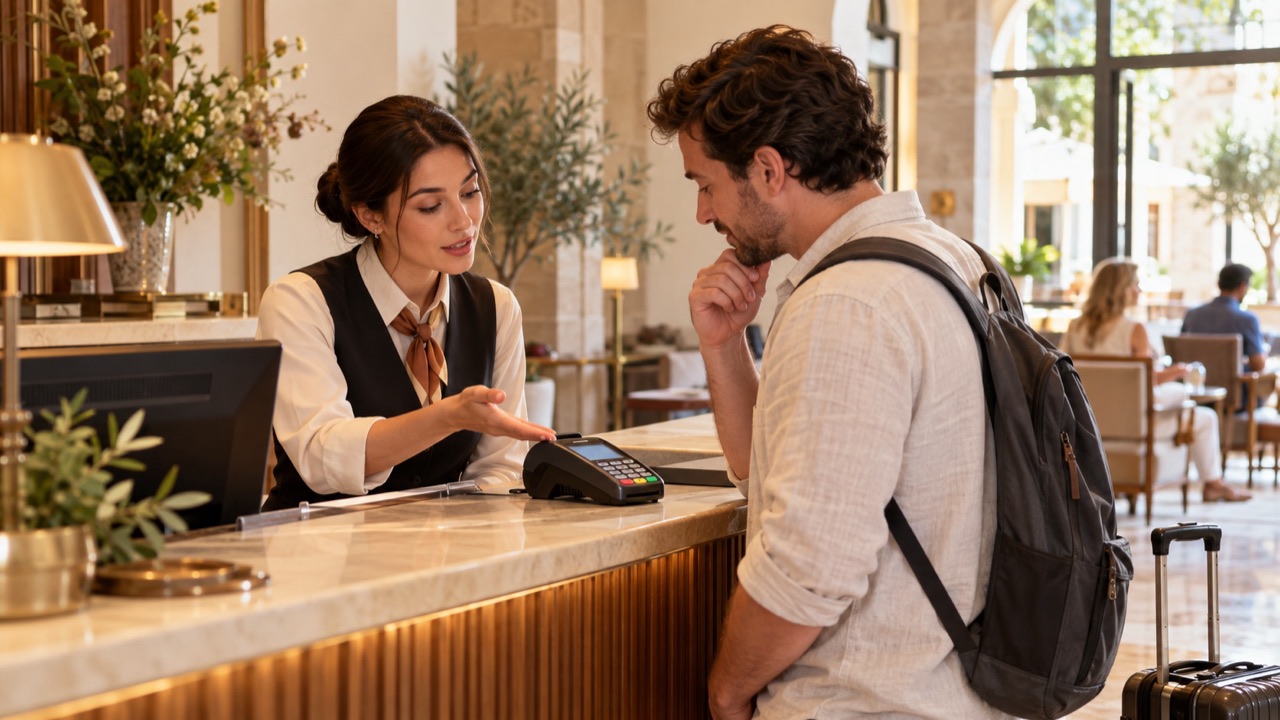
The most common billing panic at check-in: the guest's phone shows a charge of room rate plus €50 per night incidentals. They believe they've been double-billed or defrauded.

Tap to continue

Saying 'It's the computer' or 'It's our policy' makes it worse. Never say 'we didn't charge you' without explaining what did happen.

A pre-authorization is a temporary guarantee — not an executed transaction. On a credit card, it reduces available credit but takes no money. On a debit card, it temporarily freezes actual cash — which is why it appears immediately in mobile banking apps.

1/5
Receptionist explains a card-terminal authorization to a guest, using an open hand to indicate the terminal privately.
Phrases to keepClick audio icon to listen

“This is not a charge against your account — it is a temporary authorization hold that will be released automatically by your bank within 3–5 business days after departure.”

Explaining pre-authorizations calmly when a guest sees an unexpected pending charge

“On your banking app, this appears under 'pending transactions' — no funds have left your account.”

Distinguishing pending authorizations from posted debits

“A standard incidental deposit of €50 per night covers any charges to the room — bar, restaurant, laundry. The unused portion is released at checkout.”

Explaining the operational purpose and release mechanism of incidental holds

“Here is an itemized copy of your folio showing accommodation, city tax, and food and beverage separately.”

Providing transparent accounting to reassure guests on check-out

City tourist tax and room rate splits

In Italy, Spain, France, Germany, and Austria, hotels collect a mandatory municipal tourist tax that is separate from the room rate. Guests who booked on Booking.com or Agoda often don't know it exists and think it's a hidden fee.

Tap to continue

The key facts to communicate: the tax is set by the city council, not the hotel. It cannot be waived. It is per person, per night. It is collected at reception, not through the OTA.

Also understand rate splits. What a guest paid the OTA includes the platform's markup, taxes, and service fees. The hotel sees only the net rate. Don't say 'I don't know what you paid them' — explain that OTA pricing is managed independently from property billing.

1/4
Phrases to keepClick audio icon to listen

“The local tourism tax of €3.50 per person per night is established by the city council — it is collected directly here at reception and is not included in your online booking.”

Explaining mandatory municipal tourist taxes clearly and factually

“Your online booking covered the room rate. City taxes, incidentals, and any on-site services are settled directly with us.”

Clarifying what third-party vouchers include versus on-site property settlements

“Because this was booked under a non-refundable promotional rate, changes cannot be amended at the property level — but I can give you the booking agency's direct contact for any modifications.”

Directing OTA booking restrictions professionally without dismissive language

Card declines without humiliation
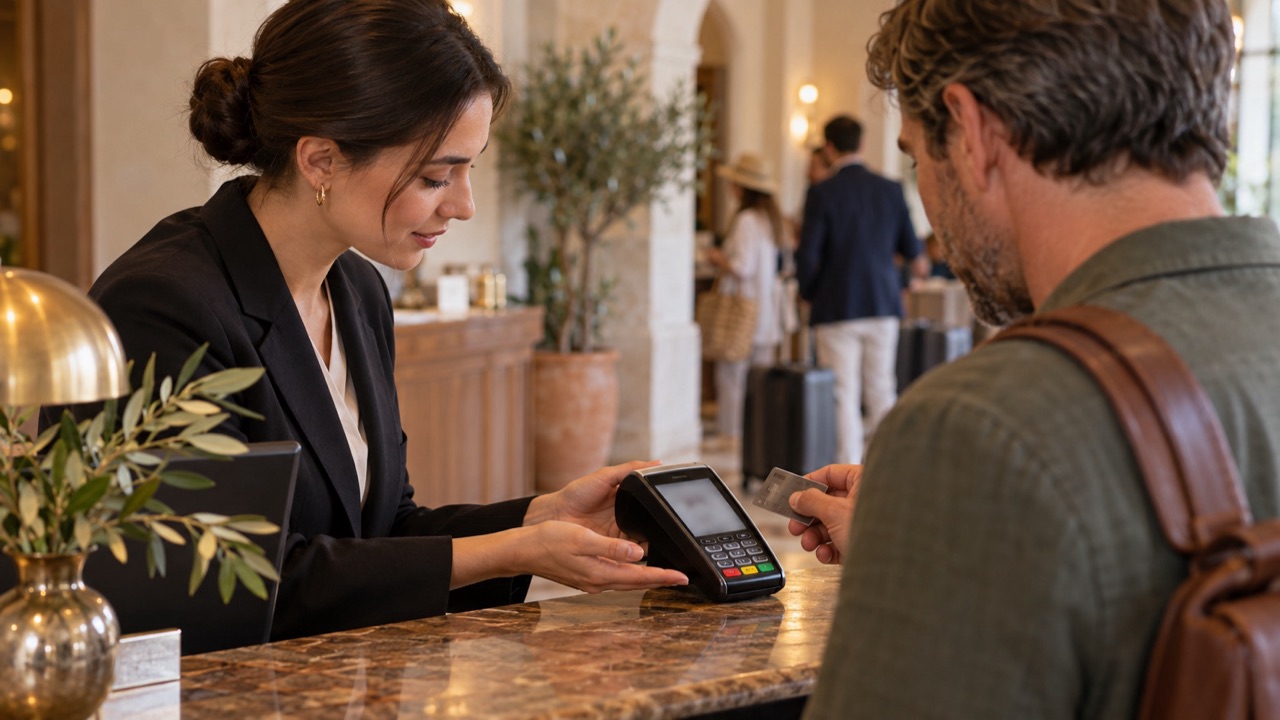
A card decline in front of other guests is one of the most face-threatening moments at the front desk. Saying 'Your card was declined' or 'There's no money' causes immediate embarrassment — and usually anger.

Tap to continue

The professional approach: say only what you know. The terminal tells you the payment did not go through; it does not tell you why. Do not guess a cause, and never suggest it is the guest's fault. Many international cards are blocked by the guest's own bank for security, but you cannot know that, so let the guest check with their bank.

Three practical steps: lower your voice, angle the terminal so only the guest can see the screen, and offer an alternative immediately. Don't leave a silence.

1/4
Close over-shoulder scene: receptionist discreetly angles a payment terminal toward its owner and offers space to try another card.
Claude AI Prompt TemplateCopy & paste into Claude with your details
Attributing terminal prompts to international banking security filters
The payment hasn't gone through. Shall we try again, or would you like to use another card?
Discreetly offering alternative payment methods without awkward pauses
Sometimes the card's own bank holds international payments. You may want to check your banking app. In the meantime, would you like to try another card or pay another way?
Soft, private phrasing spoken away from other guests in line
The terminal isn't reading that card. Shall we try another?

Quick Shift Check

What should you do the moment a guest arrives, even if you're in the middle of another task?

Already know this material?

You can take the 20-question exam any time — no need to finish every module first.

Take the exam
Hospitality English
Free Course & Verified Exam
Take Exam