Hospitality English
Free course ~90 min · 6 modulesLinkedIn-ready certificate

Hospitality English

The English you actually use on shift — free to learn.

Hotels don't need IELTS scores. They need a receptionist who can handle an overbooking at 11pm, explain a bill dispute without escalating it, and give clear directions to a guest who speaks four words of English. This course teaches the specific English that comes up in real hotel and restaurant shifts - not textbook phrases, but the sentences you actually reach for under pressure.

Who it's for
Seasonal and hospitality workers whose first language is not English: hotel staff, waiters, bartenders, resort and event staff, receptionists.

At a glance

Course
Free, online, self-paced
Certificate
€7.99, paid only after you pass
Exam
20 questions, 75% to pass, free retakes
Verification
Unique certificate ID, publicly checkable at hospitalitycertificate.com/verify
Study time
About 90 minutes, 6 modules
Issued by
Hospitality Certificate (CertHub network)

Module 6 of 6

Cultural English and Professional Limits

Politeness traps, direct and indirect complaint styles, and professional boundaries.

The phrases that sound polite to you and rude to the guest
Some phrases sound completely normal in Italian or Spanish and land badly in English. These are not grammar mistakes — the grammar is correct. The problem is register.

Tap to continue

'Actually...' — In Italian 'In realtà' and Spanish 'En realidad' are neutral corrections. In English, 'Actually, breakfast is not included' sounds condescending — as if you're scolding the guest for being wrong. Replace: 'Looking at your booking, breakfast is an optional add-on for €15 — would you like me to add it?'

'You must...' / 'You have to...' — Normal in 'Deve firmare' or 'Tiene que esperar.' In English, it sounds like a command. Replace: 'Could you please sign here?' or 'If you'd like to take a seat, I'll bring your keys the moment the room is ready.'

1/6
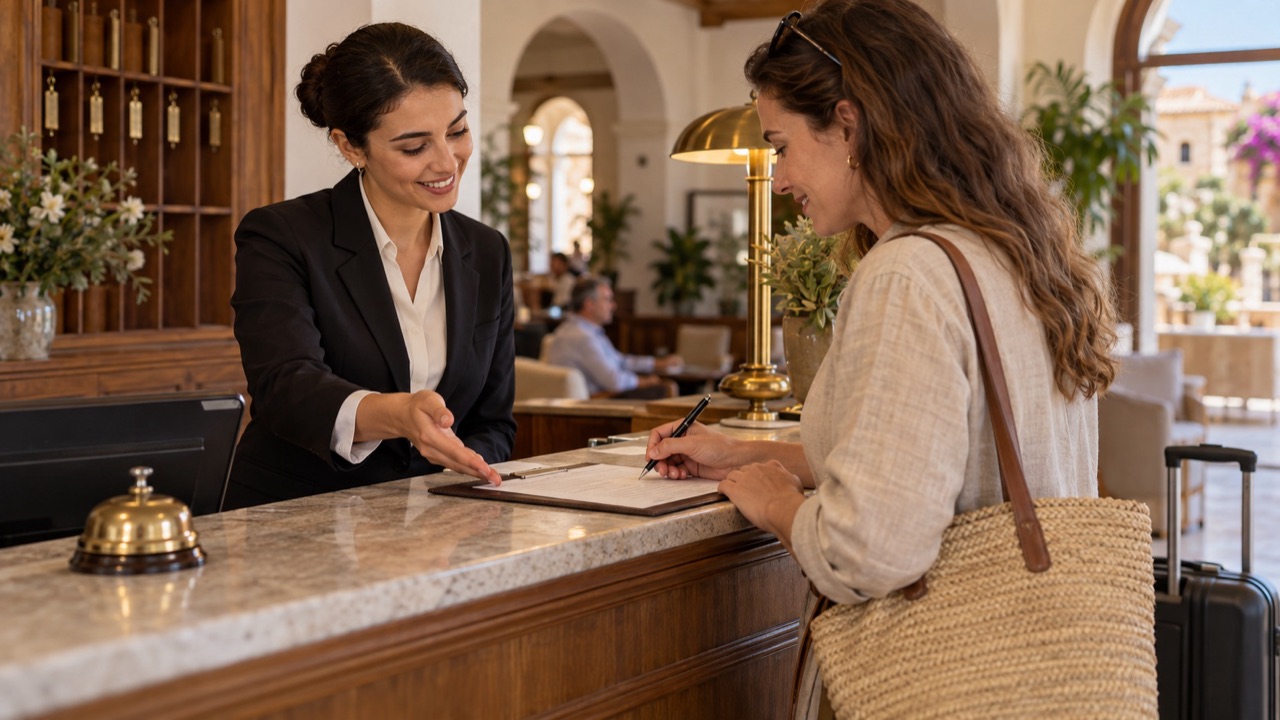
Receptionist gently indicates where a guest should sign an arrival form, with calm open-hand gesture and no readable personal data.
Phrases to keepClick audio icon to listen

“Looking at your booking, [fact] — would you like me to [alternative]?”

Clarifying reservation conditions without patronizing 'actually'

“Could you please [request]?”

Replacing authoritarian 'you must' with polite request forms

“One moment please.”

Polite pause replacing blunt 'wait'

“I'm sorry that [specific thing] fell short of what you expected.”

Direct accountability replacing empty non-apologies

“Our housekeeping team is still preparing rooms to ensure everything is fresh. While you wait, the café and pool are available and your luggage can be stored here.”

Explaining check-in constraints through hospitality care rather than 'policy'

British and American guests: the hidden differences

Guests differ a lot in how directly they complain. Some say exactly what is wrong: 'The Wi-Fi doesn't work, I need it fixed now.' Others say it softly: 'We had a bit of trouble with the Wi-Fi.' Both may mean the same thing: it did not work and they want it fixed.

Tap to continue

You will often hear the indirect style from British guests, and a more direct, enthusiastic style from many American guests. But nationality is only a weak hint. Plenty of British guests are direct and plenty of Americans are reserved. Read the person in front of you, not the passport.

How to catch a soft complaint: Listen for small words that soften a problem: 'a bit', 'slightly', 'not quite', 'a little'. Treat them as a real complaint, not a passing remark. Check instead of guessing: 'Was the Wi-Fi not working at all? I'd like to fix it for you.'

1/5
Phrases to keepClick audio icon to listen

“It sounds like that was genuinely inconvenient — let me sort that out for you.”

Responding to a softly worded complaint by taking action

“I'm glad you mentioned that. Would you like me to have someone look at that now?”

Catching quiet complaints before they become negative online reviews

“I want to make sure this is resolved before the end of your stay — shall I send someone up this afternoon?”

Offering structured solutions to guests who hesitate to make direct demands

Saying no without closing the door

Every shift includes moments where you have to say no. The skill is not avoiding no — it is saying no in a way that keeps the guest's goodwill.

Tap to continue

The structure: acknowledge what they wanted → honest single-sentence reason → best available alternative.

For professional limits — intoxicated guests, inappropriate behaviour, licensing cutoffs — depersonalize the boundary. Anchor it in safety rules or legal requirements that apply to everyone. Never make it personal.

1/5
Hotel employee calmly offers a non-alcoholic drink option to an adult guest at a bar, respectful distance and composed expression.
Phrases to keepClick audio icon to listen

“I'm afraid that's not something I'm able to offer — [honest reason]. What I can do is...”

Delivering a clear refusal paired with the closest viable alternative

“Our licensing regulations don't permit service after 1:00 AM — I'd be happy to send sparkling water and tea to your room.”

Enforcing statutory bar service cutoffs calmly and hospitably

“For guest safety, we require photo identification before re-issuing a room keycard.”

Depersonalizing security rules by emphasizing safety standards

“Please use our registered taxi queue outside reception — unmetered private drivers don't carry the commercial insurance our guests are entitled to.”

Steering guests away from unlicensed transport with clear safety rationale

Quick Shift Check

What should you do the moment a guest arrives, even if you're in the middle of another task?

You’ve completed the course

Take the 20-question exam to earn your verifiable certificate.

Add it directly to your LinkedIn profile after passing

Take the exam

€7.99 only if you pass · Instant certificate · Free retakes

Hospitality English
Free Course & Verified Exam
Take Exam