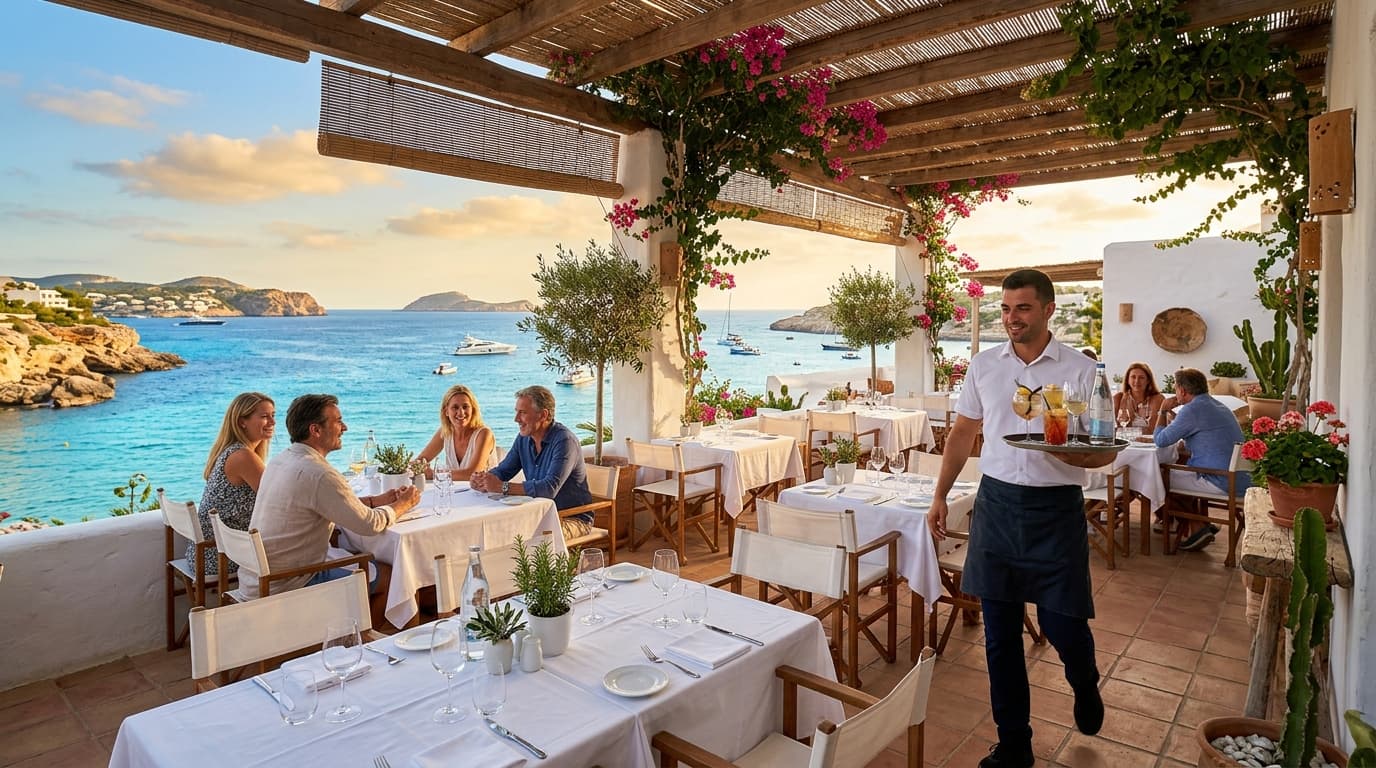
Working in hospitality in Ibiza (Balearic Islands)
Ibiza runs on seasonal hospitality workers from April to October. The XVII Convenio Colectivo de Hostelería de les Illes Balears (Balearic Hospitality Collective Agreement), signed April 2025 and valid through March 2028, sets the minimum salaries for every role. Here is what you need, what you will earn, and what the law actually requires — with every claim linked to the official source.
Sources last checked 2026-09-30. Rules change, so confirm with the linked official page before you rely on it.
Minimum monthly salaries — Ibiza hotels & restaurants
April 2025 – March 2026 (first year of the agreement)
| Role | Category A (4–5 star) | Category B (2–3 star) | Category C (1 star) |
|---|---|---|---|
| Recepcionista (Receptionist) — Level III | €1,917.50 | €1,886.28 | €1,853.96 |
| Camarero/a (Waiter/Waitress) — Level IV | €1,781.32 | €1,743.27 | €1,725.12 |
| Camarera/o de pisos (Housekeeper) — Level IV | €1,781.32 | €1,743.27 | €1,725.12 |
| Ayudante de camarero/a (Bar assistant) — Level V | €1,574.76 | €1,542.40 | €1,526.22 |
- Two annual bonuses are paid: one on 31 July and one on 21 December (Art. 27 of the agreement). These are on top of the monthly figures above.
- Second-year rates (April 2026–March 2027): Level III Cat A rises to €1,994.19; Level IV Cat A to €1,852.57. The increase is applied automatically.
- Most international resort hotels in Ibiza fall into Category A. A 1-star pension or a small bar would be Category C.
- Accommodation and meals, when provided by the employer, are counted against salary within the limits of Art. 31.
Can you work there?
EU/EEA citizens: full right to work, no permit needed
Required by lawCitizens of EU and EEA countries can live and work in Spain without a work permit. You will need to register at the local Oficina de Extranjería within three months and obtain an NIE (foreigner identification number), but you can start work before that.
Non-EU workers: employer-sponsored work visa required
Required by lawNon-EU nationals need a work and residence permit. Most seasonal workers from outside the EU are hired through Spain's annual contingente (quota) process, or through bilateral labour agreements. Your employer must apply before you arrive.
Most Ibiza contracts are fijo discontinuo (fixed-discontinuous)
Your employer must provideSeasonal work in Ibiza is typically structured as a fijo discontinuo contract: you are employed permanently but only called to work during the active season (roughly April to October). After the season ends you are suspended, not dismissed. Under the 2025 agreement you must be given at least 5 days notice before your call-back date (Art. 13).
Hotel receptionist in Ibiza (Balearic Islands)
No government licence is required to work as a hotel receptionist in Ibiza. English plus basic Spanish is expected at international resorts. The collective agreement sets your minimum salary at €1,917.50/month (Category A, first year).
No mandatory licence — but language skills are decisive
Common practiceIbiza resort hotels screen for English fluency and spoken Spanish. International chains also value a certificate of professional training (front desk or customer service). There is no government hospitality licence for this role.
Stand out with a verifiable skills certificate
- Front Desk & Reception Free course, certificate €7.99 after you pass
- Hospitality English Free course, certificate €7.99 after you pass
- Hospitality Spanish Free course, certificate €7.99 after you pass
This is a skills certificate, not a government licence. It does not replace any legal requirement above.
Waiter / waitress in Ibiza (Balearic Islands)
No government food-handler card exists in Spain since 2010. Your employer is legally required to fund and organise your food hygiene training before you start (EU Regulation 852/2004, Art. 38 of the collective agreement).
Food hygiene training — employer's legal duty, not yours
Your employer must provideSpain abolished the individual carnet de manipulador de alimentos in 2010. Under EU Regulation (EC) 852/2004, the business is responsible for ensuring all food handlers are trained. Art. 38 of the Balearic Hospitality Collective Agreement reaffirms this: the employer must fund and provide the training, including any required certificates. You do not need to arrive with a card.
Stand out with a verifiable skills certificate
- Bar & Restaurant Service Free course, certificate €7.99 after you pass
- Hospitality English Free course, certificate €7.99 after you pass
- Hospitality Spanish Free course, certificate €7.99 after you pass
This is a skills certificate, not a government licence. It does not replace any legal requirement above.
Housekeeping / room attendant in Ibiza (Balearic Islands)
No government licence is required. Ibiza's international resorts value systematic, discreet, fast-turnover housekeeping. The collective agreement places the role at Level IV, the same band as waiters.
No mandatory licence
Common practiceHousekeeping in Ibiza requires no government certificate. Large resort hotels may run internal safety and chemical-handling training on arrival. A certificate demonstrating professional standards (bed-making, eco protocols, lost-property handling) stands out in applications.
Stand out with a verifiable skills certificate
- Housekeeping Standards Free course, certificate €7.99 after you pass
- Hospitality English Free course, certificate €7.99 after you pass
- Hospitality Spanish Free course, certificate €7.99 after you pass
This is a skills certificate, not a government licence. It does not replace any legal requirement above.
Bartender in Ibiza (Balearic Islands)
No government bartender licence exists in Spain. The most competitive Ibiza bar and club positions require demonstrated cocktail and spirits knowledge. Like food service roles, food hygiene training is the employer's obligation.
No government licence, but skills are decisive
Common practiceSpain does not require a government licence to work as a bartender. Ibiza's international clubs and beach clubs (categorised as Category A) compete on cocktail quality and speed; proof of professional training gives you an advantage over candidates with only informal experience.
Food hygiene training — employer's responsibility
Your employer must provideSame as the waiter role: food hygiene training is the employer's legal duty under EU Reg. 852/2004 and Art. 38 of the collective agreement.
Stand out with a verifiable skills certificate
- Bar & Restaurant Service Free course, certificate €7.99 after you pass
- Hospitality English Free course, certificate €7.99 after you pass
- Hospitality Spanish Free course, certificate €7.99 after you pass
This is a skills certificate, not a government licence. It does not replace any legal requirement above.
Your CV for Ibiza (Balearic Islands)
Ibiza-specific CV tips
Common practice1. Name the season years (e.g. 'Ibiza season 2024, April–October') — Ibiza employers know exactly what this means and value it over vague dates. 2. List the hotel's category (4-star, 5-star) so recruiters can benchmark your experience to the collective agreement levels. 3. Include languages: English plus Spanish is the floor; Italian and German are a bonus for the German and Italian tourist markets that dominate Ibiza. 4. Add a certificate (even a short online one) to stand out from applicants with only informal experience — Ibiza's international resorts often filter CVs before interviewing. 5. Seasonal fijo discontinuo contracts mean you will be recalled each year — if you have been called back, say so. It signals reliability.
Where Ibiza employers hire
Common practiceMost recruitment happens between January and March for the April start. Useful channels: Infojobs.net (Spain's largest job board), the SOIB (Servei d'Ocupació de les Illes Balears), and the hotel chains' own careers pages (Meliá, Iberostar, Palladium all have major Ibiza properties).
The Ibiza season at a glance
Season duration
Common practiceThe main hotel and restaurant season runs April to October, peaking June to September. Some beach clubs and top-end restaurants extend to November.
Language mix on the island
Common practiceCatalan (Eivissenc dialect) is the co-official language alongside Spanish, but English is the common language at tourist-facing workplaces. Most guests are British, German, Italian, and Spanish.