Bar & Restaurant Service
Free course ~60 min · 6 modulesLinkedIn-ready certificate

Bar & Restaurant Service

The service sequence, standards, and rush survival — free to learn.

Six short modules on what bars and restaurants expect from day one, from the first greeting to a table with a problem. Study free, then take the exam when you feel ready.

Who it's for
First-season and early-career waiters, runners, bar staff, and anyone applying to restaurants, beach clubs, bars, and resorts.

At a glance

Course
Free, online, self-paced
Certificate
€7.99, paid only after you pass
Exam
20 questions, 75% to pass, free retakes
Verification
Unique certificate ID, publicly checkable at hospitalitycertificate.com/verify
Study time
About 60 minutes, 6 modules
Issued by
Hospitality Certificate (CertHub network)

Module 6 of 6

Allergens and dietary needs

The 14 allergens, what vegan and gluten-free actually mean, and how not to get it wrong.

The 14 allergens — and why you can't guess
EU law recognises 14 allergens that must be disclosed on every menu: gluten, crustaceans, eggs, fish, peanuts, soy, milk, tree nuts (almonds, walnuts, cashews), celery, mustard, sesame, sulphites, lupin, and molluscs.

Tap to continue

Do not decide yourself how serious a guest's need is. Some reactions are mild and some can put a person in hospital, and you cannot tell which from the word they use. Write down exactly what the guest tells you and pass it to the kitchen in full.

Your job is not to know every ingredient in every dish. Your job is to never guess. 'I think it's fine' is the wrong answer. Check the allergen sheet, or ask the kitchen, and come back with a real answer.

1/3
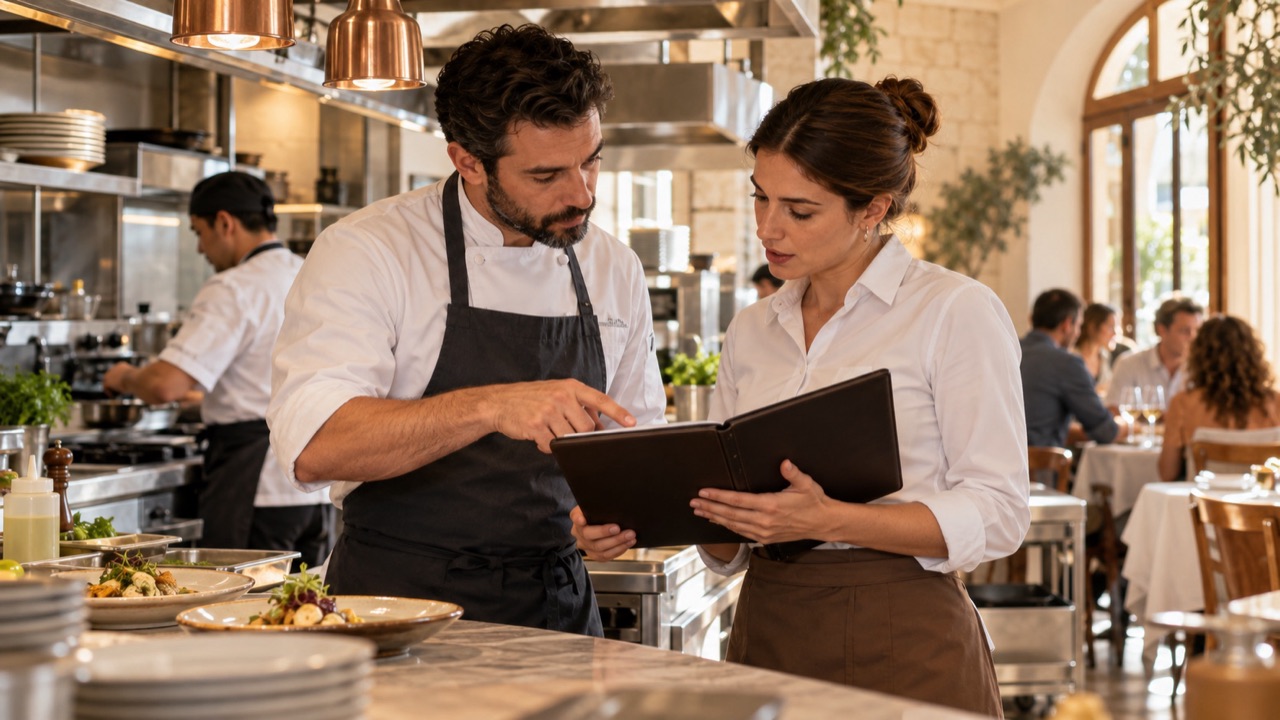
A server and chef consult a reference folder together at the kitchen pass.
Phrases to keepClick audio icon to listen

“Is that an allergy, or more of an intolerance?”

The first question — it changes how the kitchen handles the order

“Let me check the allergen sheet and come straight back to you.”

The only correct answer when you're not certain

Vegan, gluten-free, and other dietary needs

Vegan means nothing from an animal — no meat, fish, dairy, eggs, honey, or gelatine. Vegetarian covers most of that but allows dairy and eggs. Knowing the difference stops you recommending a 'vegetarian' dish to a vegan guest.

Tap to continue

Gluten-free is not a preference for most guests who ask — coeliac disease means even a trace amount of wheat causes real harm. A shared fryer, a dusted cutting board, or a garnish added without thinking can be enough. If your kitchen has a dedicated prep area for coeliac orders, say so. If it doesn't, say that too.

Halal means the meat was slaughtered and handled to Islamic law. If your kitchen isn't certified, tell the guest honestly rather than guess.

1/4
Phrases to keepClick audio icon to listen

“We have a separate prep area for gluten-free dishes — I'll flag it on the ticket.”

When the kitchen can genuinely guarantee it

“I'll double-check whether our kitchen is certified Halal before you order.”

Honest, not evasive

Keeping allergen orders clean
Cross-contamination happens faster than most people expect — a shared tong, a splash from a neighbouring pan, a sauce added at the pass without checking the ticket.

Tap to continue

In the dining room, your role is simple: make sure the allergy is written on the ticket, confirm it reached the kitchen, and check the dish when it arrives at the pass before you carry it to the table.

If you're not certain the order was handled correctly, ask. Sending a dish you're uncertain about to save time is how serious incidents happen.

1/4
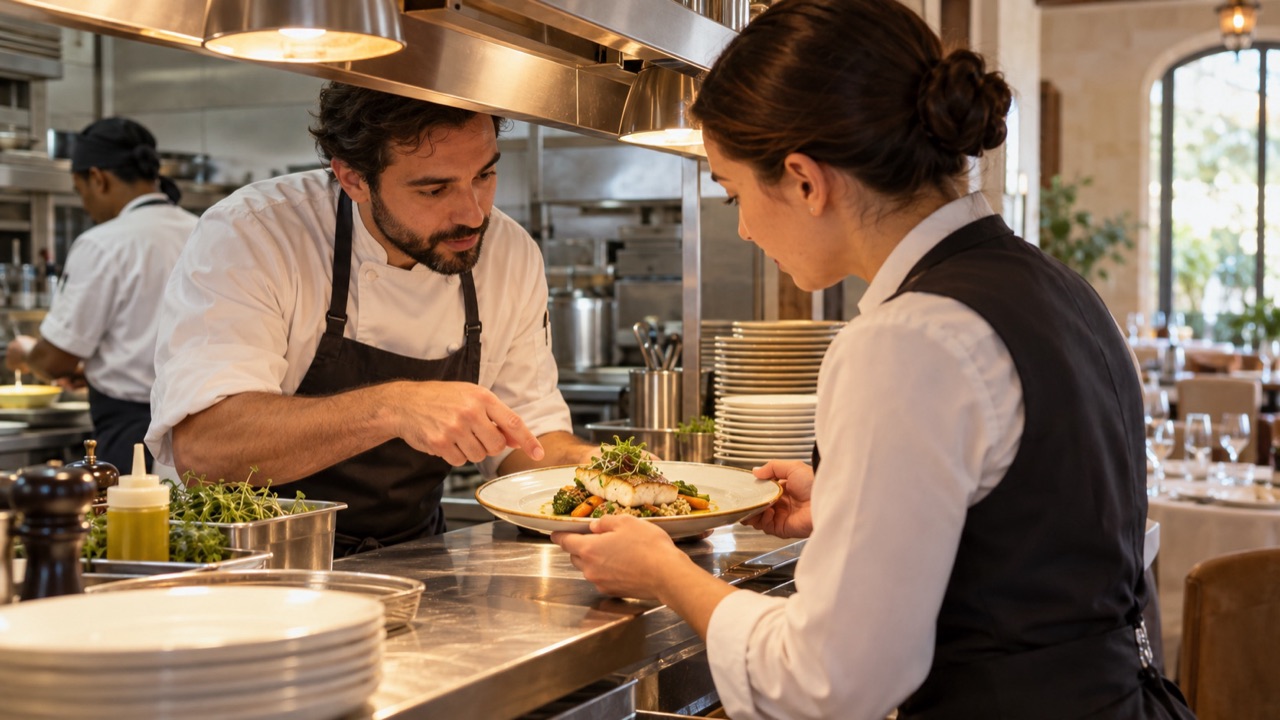
Server confirms a separately prepared plate with the chef at the pass before carrying it, clean utensils and uncluttered work surface.
Phrases to keepClick audio icon to listen

“I've flagged the nut allergy on the ticket — I'll confirm with the kitchen before it comes out.”

Closing the loop with the guest

“Mind the floor, I've just cleaned it up.”

Warning guests after a spill

One allergen order, start to finish

A worked example of the full chain. Every link has to hold.

Tap to continue

1. The guest tells you: 'I'm allergic to sesame.' 2. You ask what the kitchen needs to know: 'Thank you for telling me. Is it any trace at all, or only sesame as an ingredient?' Write down what the guest says, in their words. 3. You check before recommending: the venue's allergen information, or the chef. 'Let me check the dishes for you.' Never answer from memory. 4. You come back with a real answer: 'The grilled fish and the risotto are made without sesame. The salad dressing contains sesame, so I'd avoid that one.' 5. You write the allergy clearly on the order, in the format your venue uses, and tell the kitchen directly as well. 6. At the pass, before the plate leaves, you check that it is the allergy-checked dish and nothing has been added, for example a garnish of seeds. 7. You carry that plate yourself, separately if possible, and say at the table: 'This is your sesame-free fish.'

If the kitchen cannot guarantee a dish is safe, say so plainly: 'I'm sorry, the kitchen can't guarantee that dish is free of sesame.' Let the guest decide with the facts. Never make it sound safer than it is.

1/3
Phrases to keepClick audio icon to listen

“Is it any trace at all, or only as an ingredient?”

Finding out what the kitchen needs to know

“This is your sesame-free fish.”

Confirming the right plate at the table

Kitchen food safety basics every server should know

You will not run the kitchen, but you will hear its rules and sometimes help with them.

Tap to continue

The danger zone. Bacteria multiply fastest between fridge temperature and hot-holding temperature. Food safety training usually gives this as roughly 5°C to 60°C. The exact legal limits are set by each country: in the UK, for example, chilled food must be kept at 8°C or below and hot food at 63°C or above. So cold food goes straight back in the fridge, and hot food is not left standing on the pass.

Colour-coded boards. Many kitchens use coloured chopping boards and utensils so that raw meat, fish, vegetables and bread never share a surface. In the common colour system, purple is kept for allergen-free preparation. Always follow your own kitchen's chart, because not every kitchen uses the same colours.

1/4
Phrases to keepClick audio icon to listen

“That has been out for a while — shall I put it back in the fridge?”

Keeping cold food out of the danger zone

“New stock at the back, older at the front.”

FIFO when restocking

Quick Shift Check

How should a server handle a guest reporting a severe celiac gluten allergy?

You’ve completed the course

Take the 20-question exam to earn your verifiable certificate.

Add it directly to your LinkedIn profile after passing

Take the exam

€7.99 only if you pass · Instant certificate · Free retakes

Bar & Restaurant Service
Free Course & Verified Exam
Take Exam