How to get a waiter job in a hotel with no experience: what the trial shift actually tests
Hotel F&B managers hire on trial shifts, not CVs. Here is the sequence they watch for, what hurts an application, and how pre-training changes your hiring odds.
Key Takeaways at a Glance
Hiring Decision
80% based on trial shift performance (UK Hospitality 2024)
Trial Shift Duration
Typically 2 to 4 hours in live service
Critical Mistake
Lack of table awareness and open-handed posture
Preparation Advantage
Pre-trained sequence of service and billing protocols
- 1.Why hotel restaurant hiring is fundamentally decided on the floor, not on paper
- 2.The distinct standards of hotel dining: brand audits vs casual eateries
- 3.Hour 1 of your trial shift: grooming, posture, and mise-en-place inspection
- 4.Hour 2: the sequence of service in real-time dining operations
- 5.Hour 3: clearing tables, glassware etiquette, and open-handed body language
- 6.The fatal trial shift blunders that disqualify beginners immediately
- 7.How to prepare before walking through the hotel staff entrance
- 8.Prove your service readiness with an employer-verifiable certificate
Why hotel restaurant hiring is fundamentally decided on the floor, not on paper
When applying for a waiting or food and beverage service position in a hotel, your CV is only an entry ticket to get your foot in the door. In the food and beverage industry, managers know that an impressive resume cannot predict whether a candidate has the stamina, balance, situational awareness, and calm demeanor needed to survive a chaotic Friday night dining service.
For this reason, over 80 percent of hotel restaurant hiring decisions are made based on the candidate's performance during a practical trial shift (trade test or stage), typically lasting two to four hours. During this trial, the Restaurant Manager, Head Waiter, and floor supervisors observe your every movement on the dining floor.
According to the UK Hospitality Workforce Review 2024, more than half of entry-level service applicants fail their trial shift within the first forty-five minutes. Failure is rarely caused by a lack of natural charm; it occurs because untrained beginners violate fundamental service mechanics that could easily have been learned in advance.
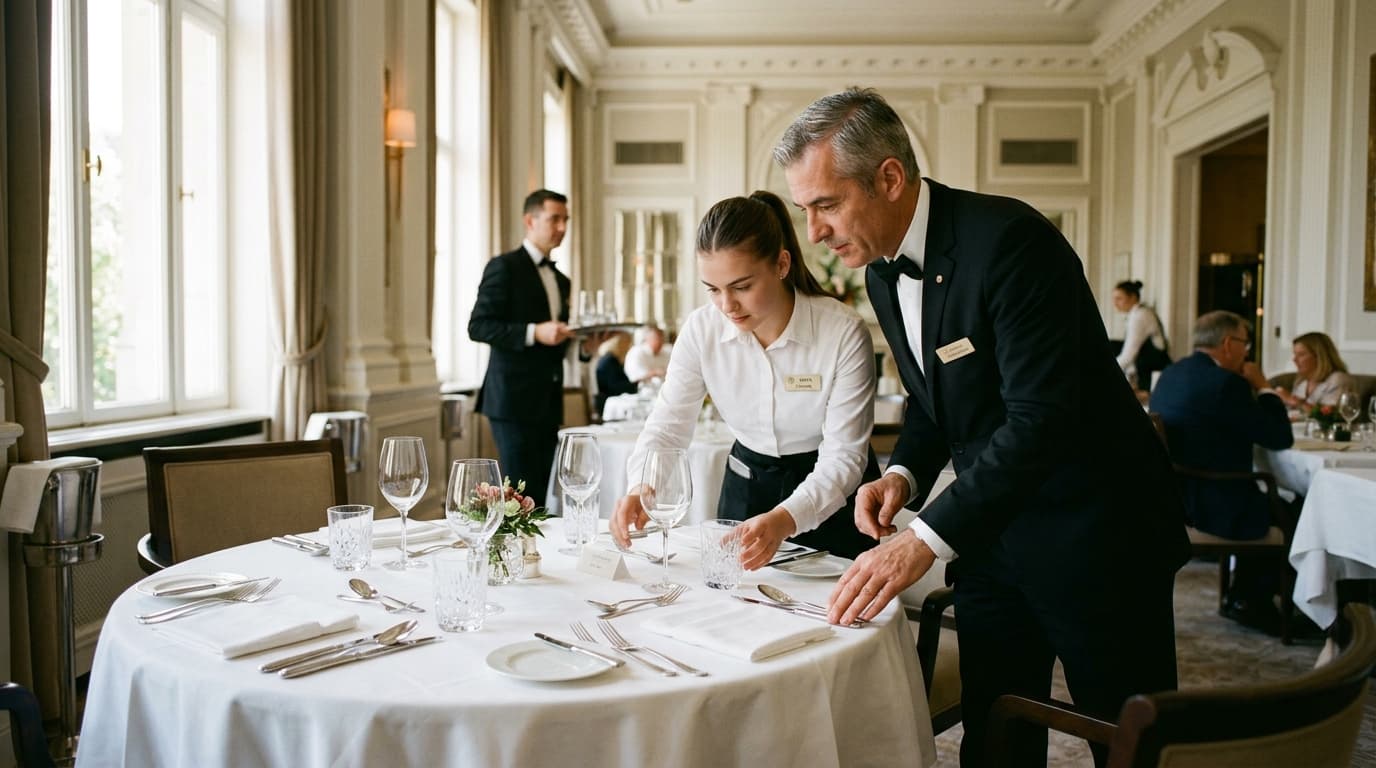
The distinct standards of hotel dining: brand audits vs casual eateries
Working as a waiter in a branded hotel is fundamentally different from serving in a casual neighborhood diner. Hotel dining outlets operate under rigorous standard operating procedures (SOPs) and undergo unannounced brand quality audits conducted by international inspection organizations such as Forbes Travel Guide, Leading Hotels of the World, or AAA.
During an audit, inspectors evaluate precise service timelines: was water poured within two minutes of seating? Were drinks served from the guest's right side? Did the server announce each dish by name upon placement? In a casual restaurant, small deviations are overlooked; in a hotel, a failed service audit directly impacts departmental management bonuses and brand ranking.
When an F&B manager conducts a trial shift with a beginner, they are watching whether the candidate exhibits natural respect for standardized procedures. Demonstrating that you already understand service choreography proves you are a low-risk hire who will not pull down audit scores.
Hour 1 of your trial shift: grooming, posture, and mise-en-place inspection
Your trial shift begins the moment you arrive at the hotel employee entrance. F&B supervisors evaluate your grooming with meticulous scrutiny before you are allowed anywhere near the restaurant floor. In luxury hotels, grooming standards are non-negotiable: polished black leather shoes, clean pressed trousers, hair neatly secured, minimal jewelry, clean trimmed fingernails, and no strong perfumes that interfere with wine aromas.
During the first hour, you will typically be assigned to the pantry or service station to assist with mise-en-place — the French culinary term for having everything in its proper place before service begins. You will be asked to polish glassware with steam and lint-free cloths, wrap cutlery, fold napkins, and replenish condiment caddies.
Supervisors use this initial hour to evaluate your work ethic and manual precision. Do you handle glasses by their stems rather than touching the bowl? Do you inspect cutlery for water spots before rolling it? Do you move with urgency, or do you stand around waiting to be told what to do? Showing initiative during prep work earns immediate respect.
Hour 2: the sequence of service in real-time dining operations
As dinner service begins and guests fill the dining room, you will be paired with a senior station waiter (Chef de Rang) to observe and assist with live table operations. This is where your understanding of the formal sequence of service is put to the test.
You must demonstrate the open-handed service technique: always serving food and pouring beverages from the guest's right side using your right hand, with your arm opening toward the guest rather than crossing across their chest. Bread plates and butter knives are placed to the left.
When delivering dishes from the kitchen pass, you must never carry plates haphazardly. Using the three-plate carrying technique — holding two plates securely in the non-dominant hand while serving with the dominant hand — is mandatory in any professional hotel dining room. Demonstrating this balance smoothly instantly convinces the manager of your potential.
Hour 3: clearing tables, glassware etiquette, and open-handed body language
Clearing tables (débarrassage) is another critical trial shift test. In hotel dining rooms, plates are never scraped or stacked noisily in front of seated guests. The server clears from the guest's right side, stacking plates discreetly on their left hand behind the guest's line of vision.
Cutlery must be secured silently on the first plate using the thumb-lock technique, with food scraps swept quietly out of sight. Glasses are cleared using a small non-slip service tray held in one hand, never by picking up multiple wine stems by their rims between your fingers like a bunch of flowers.
Throughout the entire service, your body language is monitored. A professional hotel waiter moves with smooth, upright posture, maintains constant peripheral table awareness, and avoids leaning on service stations or crossing their arms. Walking with purposeful elegance signals to guests and managers alike that you belong on the floor.
The fatal trial shift blunders that disqualify beginners immediately
Understanding the common mistakes that ruin trial shifts allows you to avoid them entirely. The most immediate disqualifier is poor hygiene: touching your face or hair on the floor, coughing without stepping away, or carrying ice cubes with your bare fingers instead of using an ice scoop.
Another fatal blunder is panic during peak rush periods. When multiple orders ring simultaneously and the kitchen pass is crowded, beginners often freeze or rush haphazardly, dropping cutlery or bumping into colleagues. Experienced servers know to slow down, take deep breaths, communicate clearly ('Behind you!', 'Coming through!'), and prioritize urgent tasks.
Finally, neglecting allergen safety will end a trial shift instantly. If a guest asks whether a sauce contains gluten, nuts, or dairy, an untrained applicant might guess or say 'I think it's fine.' In a hotel, guessing can cause life-threatening anaphylactic reactions. The correct, professional response is: 'Allow me to confirm the exact ingredients with the chef immediately, Sir.' This discipline demonstrates true professionalism.
How to prepare before walking through the hotel staff entrance
You do not have to wait until you are standing in a busy hotel kitchen to learn these operational standards. The smartest candidates invest a few hours before their trial shift studying professional hotel food and beverage protocols.
Practice the three-plate carrying technique in your kitchen using durable dinner plates until you can walk across a room smoothly without shaking. Practice balancing a tray loaded with full water glasses on your fingertips at shoulder height.
Familiarize yourself with standard hotel POS terminology, table setting geometry, and wine service rituals. When you walk into your trial shift equipped with this foundational knowledge, you will not feel like an overwhelmed novice; you will execute service commands with natural confidence.
Free Course
Bar & Restaurant Service
Learn to measure and reduce your OTA dependency — free modules, verifiable certificate.
Prove your service readiness with an employer-verifiable certificate
To walk into your first hotel restaurant trial shift with complete confidence, formal preparation is your strongest asset. Hospitality Certificate offers a dedicated Bar & Restaurant Service course that is 100 percent free to study online. The curriculum covers sequence of service, tray balance mechanics, open-handed clearing, food allergen regulations, and hotel POS room billing procedures.
The course concludes with an online assessment requiring a 75% passing threshold to validate your operational readiness. If you do not pass on your first attempt, you have access to free unlimited retakes to review the modules and test again at zero cost. Once you pass with 75% or higher, your official instant certificate can be claimed for an issuance fee of only €7.99.
Your credential includes a unique certificate ID (HC-2026-XXXXXXXX) recorded in our public verification database. Hotel F&B directors and restaurant managers can instantly verify your qualification on our public verification page at hospitalitycertificate.com/verify without login friction. Adding this employer-verifiable certificate to your CV proves your dedication and helps you pass your trial shift with ease.
Bar & Restaurant Service
The service sequence, standards, and rush survival — free to learn. Access all study modules free, then take the exam to earn your certificate.