Housekeeping Salary in Italy: CCNL Rates and Net Pay
Real housekeeping wages in Italian hotels: CCNL Turismo wage levels, seasonal resort accommodation deductions, 14 mensilita bonuses, and take-home pay.
Key Takeaways at a Glance
CCNL Base Wage (Livello 6)
€1,507.45 / month gross
Contract Payment Rhythm
14 Mensilità + TFR Severance
Estimated Net Take-Home
€1,180 - €1,340 / month
Resort Room & Board
Provided in ~75% of seasonal ads
- 1.How hotel housekeeping wages are regulated in Italy
- 2.CCNL job levels: Cameriera ai piani to Governante
- 3.The 14 mensilità and TFR severance pay for room attendants
- 4.City hotels vs seasonal resorts: Lake Garda, Sardinia, and Dolomites
- 5.Room and board (vitto e alloggio): legal caps and disposable income
- 6.Direct hotel employment versus cooperative cleaning agencies
- 7.Physical workload standards: room quotas and safety
- 8.How to advance your housekeeping career in Italy
How hotel housekeeping wages are regulated in Italy
In Italy, room attendants (cameriere ai piani) and hotel cleaning staff represent the foundational backbone of the accommodation sector. Housekeeping salaries are strictly governed by the national collective labor agreement for tourism (CCNL Turismo - Settore Alberghi), signed by employer confederations including Federalberghi and major trade unions.
Unlike unregulated domestic cleaning work, hotel housekeeping under the CCNL provides strict legal protections: mandatory wage floors, paid holiday allowances (ferie and permessi), workplace accident insurance (INAIL), healthcare coverage (Fondo FAST), and guaranteed severance pay upon contract completion.
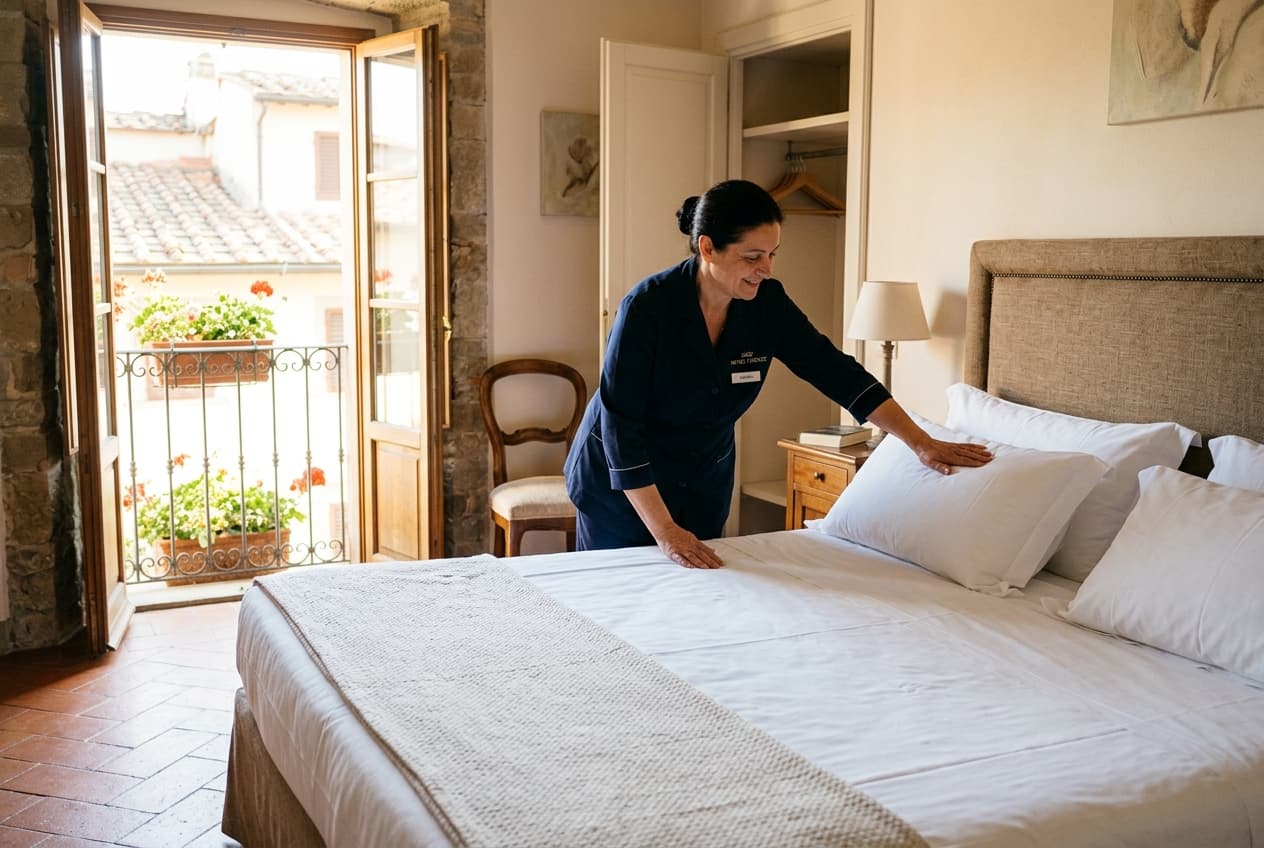
CCNL job levels: Cameriera ai piani to Governante
The CCNL Turismo classifies housekeeping staff into specific professional levels (livelli retributivi), establishing minimum gross monthly pay floors for 40-hour full-time contracts:
| CCNL Livello | Housekeeping Job Title | Gross Monthly (14 checks) | Estimated Net Take-Home | Typical Duties |
|---|---|---|---|---|
| Livello 6 | Cameriera ai Piani / Facchino | €1,507.45 / mo | €1,180 - €1,240 / mo | Daily stayover cleaning, departure turns, linen sorting |
| Livello 6 Super | Cameriera ai Piani Qualificata | €1,529.13 / mo | €1,200 - €1,260 / mo | Suite turn-down, VIP room preparation, minibar restocking |
| Livello 5 | Seconda Governante / Floor Checker | €1,590.27 / mo | €1,250 - €1,320 / mo | Room quality inspection, linen inventory, team coordination |
| Livello 4 | Prima Governante / Executive Housekeeper | €1,695.69 / mo | €1,350 - €1,440 / mo | Departmental scheduling, chemical safety compliance, budget oversight |
Scroll horizontally for full table →
The 14 mensilità and TFR severance pay for room attendants
Italian labor contracts distribute annual pay across fourteen disbursements. Employees receive twelve standard monthly paychecks plus two full bonus checks: the tredicesima (Christmas bonus) paid in December and the quattordicesima (summer bonus) paid in July. For seasonal staff, these extra payments are prorated based on months worked.
In addition, every contract accumulates severance pay (Trattamento di Fine Rapporto, or TFR). Employers set aside approximately 7.4% of your gross earnings into a state-regulated severance reserve. When your contract ends at the conclusion of a season, this accumulated sum is paid directly into your bank account, providing an essential financial cushion.
City hotels vs seasonal resorts: Lake Garda, Sardinia, and Dolomites
Housekeeping employment in Italy divides into two distinct operational environments: year-round city hotels and high-intensity seasonal resorts.
In major art and commercial cities (Rome, Milan, Florence, Bologna), positions are generally permanent or multi-month contracts with staff living in private rentals. In seasonal resort hubs (Lake Garda, the Amalfi Coast, Sardinia, Rimini, and Alpine ski resorts in Trentino-Alto Adige), contracts run for 5 to 7 months and almost always include staff accommodation.
Room and board (vitto e alloggio): legal caps and disposable income
For seasonal workers coming from southern Italy or abroad, resort contracts offering vitto e alloggio (room and board) provide extraordinary savings potential. Under CCNL regulations, room and board deductions are strictly regulated and legally capped (typically under €160 to €200 per month).
A room attendant earning €1,250 net per month who receives free meals and shared staff housing can save €1,000 or more every month. In six months of summer work, an attendant can return home with €6,000 to €7,500 in liquid savings plus accrued TFR severance and seasonal unemployment benefits (NASpI).
Seasonal Savings Advantage
Because housing and daily meals are covered at resort properties, seasonal housekeepers in Italy routinely save more money than city workers earning higher nominal salaries who spend €600/month on rent and utilities.
Direct hotel employment versus cooperative cleaning agencies
When applying for housekeeping jobs in Italy, it is critical to determine who is issuing your contract. The industry features two distinct employment models:
Direct Employment (Assunzione Diretta): You are hired directly by the hotel under the CCNL Turismo. You receive full union protections, 14 mensilità, TFR, and regulated room cleaning quotas.
Subcontracted Cooperatives (Società di Pulizie / Cooperative): Some hotels outsource housekeeping to external agencies. While legitimate cooperatives operate lawfully, some apply lower-paying collective agreements (such as the CCNL Multiservizi) or pay per cleaned room (a camera) rather than per hour. Always prioritize direct hotel contracts under the CCNL Turismo.
Physical workload standards: room quotas and safety
Housekeeping is physically demanding work requiring stamina, precision, and ergonomic discipline. In quality 4-star and 5-star hotels, room quotas typically range from 12 to 16 departure rooms or 18 to 22 stayover refreshes per 8-hour shift.
Italian workplace safety regulations (D.Lgs. 81/08) require employers to provide Personal Protective Equipment (PPE), safe chemical handling training for sanitizers, and ergonomic guidelines to prevent repetitive strain injuries.
How to advance your housekeeping career in Italy
Hotels actively seek reliable housekeepers who understand luxury room presentation standards, chemical safety protocols, and discreet guest communication.
If you're preparing to work in Italy, a verified certificate can make your application stand out. The Housekeeping Standards course on Hospitality Certificate is free to study and takes about 2 hours — and a passing exam score earns you a verifiable digital certificate employers can check at /courses/housekeeping-standards.
Housekeeping Standards
The professional room sequence and hotel standards — free to learn. Access all study modules free, then take the exam to earn your certificate.