Housekeeping certificate for hotel jobs: what the role actually requires
What hotel housekeeping supervisors look for in new hires: the standards, the physical demands, and how a verifiable certificate in housekeeping puts you ahead.
Key Takeaways at a Glance
Seasonal Share
~42% of seasonal Italian hotel hires (ISTAT 2024)
Room Turnaround Target
25 - 30 minutes for checkout clean
Safety Standard
COSHH & Chemical Sanitization Protocol
Career Ladder
Room Attendant to Floor Housekeeper / Executive
- 1.The foundational backbone of hotel guest satisfaction and profitability
- 2.The daily operational reality: room quotas, linen logistics, and physical pacing
- 3.Step-by-step room turnaround protocols: the 30-minute standard sequence
- 4.Sanitization chemistry and hygiene standards: hospital-grade disinfection
- 5.Ergonomics and injury prevention: working efficiently without burnout
- 6.Quality inspection checklists: what floor supervisors examine with a white glove
- 7.Career progression: moving from room attendant to supervisor and executive housekeeper
- 8.Demonstrating professional standards with an employer-verifiable certificate
The foundational backbone of hotel guest satisfaction and profitability
Housekeeping is the single largest operational department in the hotel industry, employing more personnel than front desk and administration combined. While receptionists welcome guests and sales managers book conferences, the guest's physical experience of the hotel is fundamentally defined by the cleanliness, hygiene, and comfort of their guest room.
No amount of lobby grandeur or complimentary champagne can compensate for a dirty bathroom, stained bed linen, or dust on a bedside table. Online review statistics across Booking.com and TripAdvisor consistently confirm that cleanliness is the primary ranking factor influencing overall property ratings and repeat booking intent.
According to the ISTAT Seasonal Employment Report 2024, housekeeping staff account for approximately 42 percent of all seasonal hospitality hires in Italy, with comparable figures across Spain, France, and Greece. Because demand is continuous and turnover is high, housekeeping represents the most accessible and reliable entry point into hotel employment.
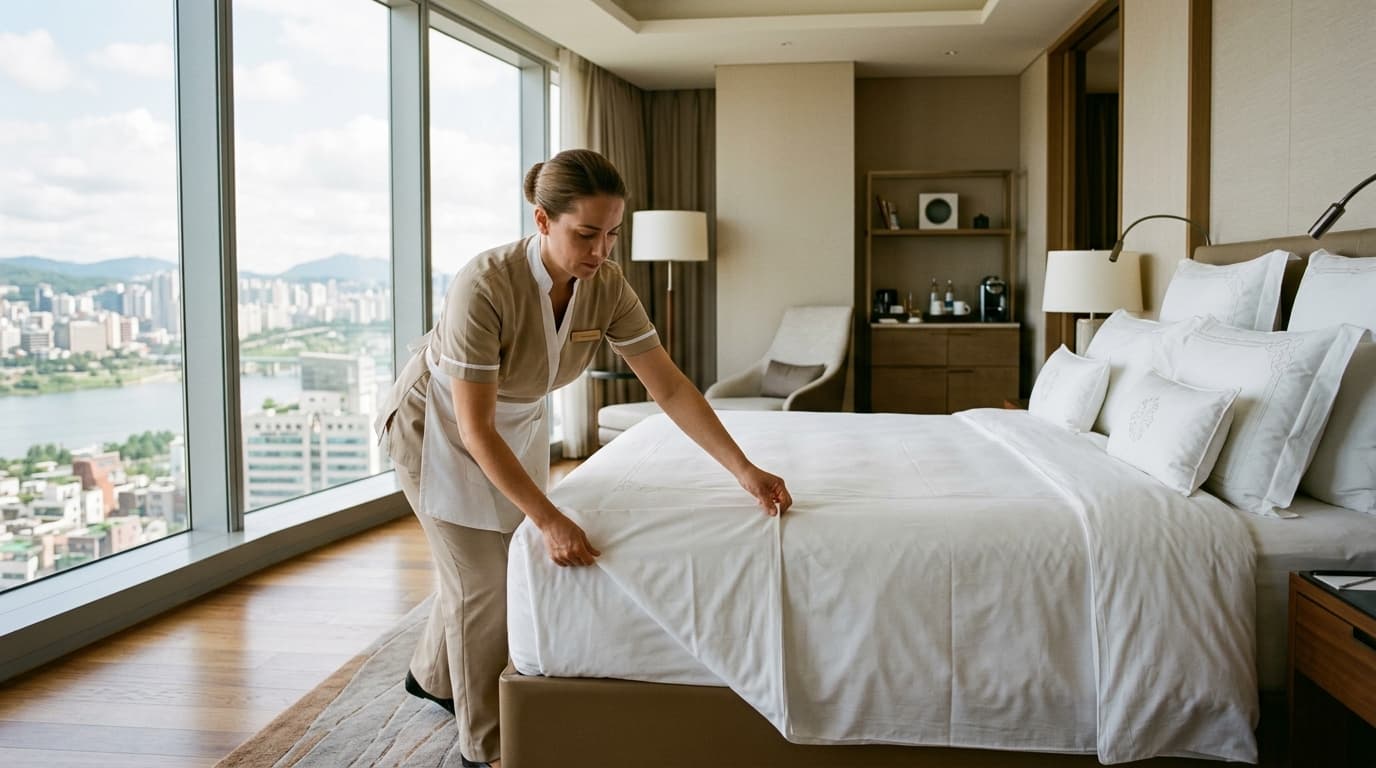
The daily operational reality: room quotas, linen logistics, and physical pacing
A career in hotel housekeeping requires stamina, systematic pacing, and strict adherence to daily productivity targets. A typical room attendant is assigned a daily quota of 14 to 18 guest rooms per eight-hour shift, depending on whether the rooms are stay-overs (occupied rooms receiving refresh service) or full checkout departures requiring complete linen changes.
For a checkout departure clean, an attendant must strip all bed linens and towels, scrub and sanitize the entire bathroom, vacuum carpets, dust all surfaces, restock guest amenities and minibar items, and make the bed to brand specification within a strict 25 to 30-minute window.
Efficiency is achieved through organized trolley setup (mise-en-place). An experienced room attendant stocks their housekeeping cart at 08:00 AM with exact quantities of fresh sheets, pillowcases, bath sheets, hand towels, cleaning chemicals, microfibre cloths, and bathroom toiletries. Running back and forth to linen closets destroys productivity and leads to unfinished quotas.
Step-by-step room turnaround protocols: the 30-minute standard sequence
Hotel housekeeping is executed according to an exact chronological sequence designed to prevent cross-contamination and guarantee that no area is overlooked.
The standard sequence begins by knocking three times, announcing 'Housekeeping,' opening windows for ventilation, and checking for forgotten guest belongings in closets and safes. Next, all soiled linens and towels are stripped and bagged without touching clean surfaces. All trash bins are emptied and relined.
Bathroom cleaning follows hospital-grade sanitation protocols: applying disinfectant cleaners to the shower, tub, toilet, and vanity, allowing adequate chemical contact dwell time, scrubbing grout lines, polishing chrome fixtures to remove water spots, and replacing fresh towels. Finally, the attendant makes the bed, damp-dusts surfaces from top to bottom, vacuums from the furthest corner toward the exit door, and conducts a final visual sweep.
Sanitization chemistry and hygiene standards: hospital-grade disinfection
Modern hotel housekeeping relies on commercial-grade cleaning chemistry governed by occupational health frameworks such as the UK COSHH (Control of Substances Hazardous to Health) standards and equivalent European directives. Attendants must understand chemical dilution ratios, contact times, and personal protective equipment (PPE).
Color-coded microfibre cloth systems are strictly enforced in branded properties to prevent bacterial cross-contamination. Under standard protocols, red cloths are reserved exclusively for toilets and bidets, yellow cloths for sinks and showers, green cloths for dining and kitchen surfaces, and blue cloths for general bedroom furniture dusting.
Using the wrong cloth on a bedside table or mixing cleaning agents containing bleach and ammonia creates severe health hazards. Supervisors prioritize hiring candidates who already demonstrate knowledge of color coding and chemical safety protocols.
Ergonomics and injury prevention: working efficiently without burnout
Because room cleaning is physically demanding work involving repetitive bending, lifting, and pushing heavy carts, ergonomic technique is a core component of professional training.
According to the European Agency for Safety and Health at Work (EU-OSHA) 2024 Hospitality Ergonomics Brief, musculoskeletal disorders represent over 50 percent of occupational health claims in the lodging sector. Learning how to tuck sheets using knee-bend squats rather than lower-back flexion is vital for long-term career health.
Professional training teaches attendants how to maneuver heavy laundry carts smoothly, how to lift mattresses using proper body mechanics, and how to pace physical exertion evenly across an entire shift without exhaustion.
Quality inspection checklists: what floor supervisors examine with a white glove
Before a cleaned room is updated to 'Inspected / Vacant' in the hotel Property Management System and made available to incoming guests, it is audited by a Floor Housekeeping Supervisor or Executive Housekeeper using a detailed multi-point inspection checklist.
Supervisors examine subtle details that untrained cleaners miss: checking for hair on bathroom tile grout, inspecting the interior of the electric kettle for limescale, looking under the bed for discarded trash, checking that curtain shears hang straight, and running a finger across high picture frames for dust.
Bed making is judged on architectural geometry: tight hospital corners, wrinkle-free sheets, centered duvets with crisp folds, and perfectly fluffed pillows aligned with headboard seams. Passing supervisor inspections consistently is the primary benchmark for career advancement.
Career progression: moving from room attendant to supervisor and executive housekeeper
Housekeeping is widely misunderstood as a dead-end entry role. In reality, it offers one of the most reliable and rapid career progression paths in the entire hospitality sector.
A reliable room attendant who demonstrates meticulous cleanliness and steady pacing can advance to Floor Supervisor within 12 to 18 months, taking on responsibility for inspecting thirty to forty rooms per day, managing linen supplies, and coaching junior staff.
From there, supervisors advance to Assistant Housekeeper and Executive Housekeeper. An Executive Housekeeper at a 300-room hotel oversees a multi-million euro operating budget, manages a team of forty staff members, negotiates commercial laundry contracts, and sits on the hotel's Executive Committee alongside the Director of Sales and General Manager.
Free Course
Housekeeping Standards
Learn to measure and reduce your OTA dependency — free modules, verifiable certificate.
Demonstrating professional standards with an employer-verifiable certificate
Whether you are seeking your first seasonal hotel job or looking to advance into supervisory roles, certified vocational training provides instant credibility. Hospitality Certificate offers a comprehensive Housekeeping Standards course that is 100 percent free to study online, covering room cleaning workflows, chemical safety, infection control, and inspection standards.
The course concludes with an online assessment requiring a 75% passing threshold to prove your mastery of operational hygiene protocols. If you do not achieve 75% on your first try, you have access to free unlimited retakes to study and repeat the exam at no charge. Upon passing with 75% or higher, your official instant certificate can be claimed for an issuance fee of only €7.99.
Every credential includes a unique certificate ID (HC-2026-XXXXXXXX) securely recorded in our public verification database. Hotel housekeeping supervisors and HR recruiters can verify your qualification at any time on our public verification page at hospitalitycertificate.com/verify without creating an account. Adding this employer-verifiable certificate to your CV confirms your readiness to deliver spotless guest rooms from day one.
Housekeeping Standards
The professional room sequence and hotel standards — free to learn. Access all study modules free, then take the exam to earn your certificate.