Bar and restaurant service certificate: how to get a hotel F&B job with no experience
What hotel F&B managers look for when hiring bar and restaurant staff with no experience, and how a verifiable service certificate changes your odds.
Key Takeaways at a Glance
Average F&B Starting Pay
€1,450 - €1,800 net/mo (EU) / $16-20/hr (US)
Core Operational Test
Tray Balance & 3-Plate Carrying Drill
Service Protocol
Forbes / Leading Hotels Sequence Standards
Key Differentiator
Room Billing Folio & Allergen Protocol Mastery
- 1.How hotel food and beverage differs from standalone restaurants
- 2.The multi-outlet ecosystem: breakfast buffet, room service, banquet, and lounge
- 3.The formal sequence of service: mastering the guest journey
- 4.The technical drills tested in hotel F&B trial shifts
- 5.Beverage fundamentals: wine presentation, coffee preparation, and bar mise-en-place
- 6.Allergen compliance, food safety laws, and room charge billing systems
- 7.How to format your CV for hotel F&B without previous hotel employment
- 8.Get certified in professional bar and restaurant service protocols
How hotel food and beverage differs from standalone restaurants
Many job seekers assume that serving food and drinks in a hotel is identical to working in an ordinary high-street bistro. In reality, hotel Food and Beverage (F&B) operations function under an entirely different set of corporate standards, quality audits, and cross-departmental workflows. A hotel server is an ambassador for an entire hospitality ecosystem.
In a standalone restaurant, guests leave after paying their bill and rarely interact with the establishment again. In a hotel, dining guests are often in-house residents who will remain on the property for days. A service failure at breakfast affects the guest's perception of housekeeping, the front desk, and the hotel brand as a whole, directly influencing their post-stay review scores.
According to the Eurostat Hospitality F&B Employment Review 2024, hotel food and beverage departments employ over 32 percent of all lodging personnel across Europe. Hotel F&B managers look specifically for candidates who appreciate this interconnected dynamic and adhere strictly to standard operating procedures.
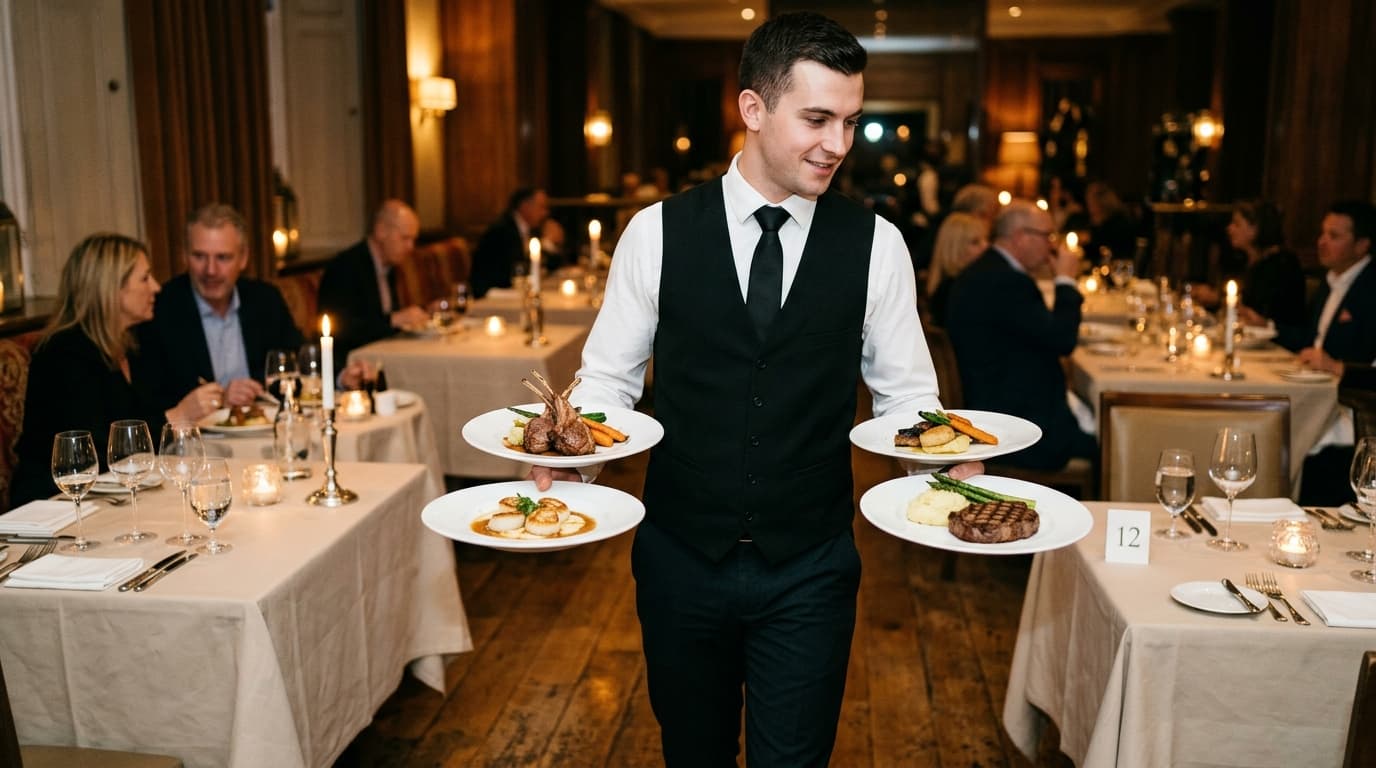
The multi-outlet ecosystem: breakfast buffet, room service, banquet, and lounge
Unlike a single-purpose restaurant, hotel F&B encompasses multiple operational divisions under one roof. On any given day, an F&B service attendant may rotate between the morning breakfast buffet, the hotel bar lounge, private in-room dining, and formal banquet functions.
The morning breakfast service is the highest-volume operation in the hotel. Hundreds of guests descend upon the dining room within a narrow two-hour window, requiring servers to clear tables rapidly, replenish buffet stations according to strict health codes, and memorize table numbers flawlessly. In-room dining, meanwhile, requires discrete etiquette, specialized trolley setup, and precise tray transportation.
Banquet and conference catering demands synchronization. Serving a four-course gala dinner to three hundred conference attendees requires team-based plate delivery, silent clearing techniques, and strict adherence to banquet event orders (BEOs). Understanding these distinct operational formats before your first interview sets you far apart from ordinary applicants.
The formal sequence of service: mastering the guest journey
Luxury hotels and upscale chains follow a structured sequence of service that dictates every guest interaction from arrival to departure. This standardized workflow ensures consistent excellence across all shifts and locations.
The sequence begins with an immediate warm greeting within thirty seconds of seating, followed by presenting menus from the guest's right side and taking beverage orders. Servers must execute bread and butter placement, beverage service without touching glass rims, and simultaneous food delivery using the open-handed service technique, where the server's arm never crosses directly in front of the guest's face.
According to the Forbes Travel Guide 2024 Service Standards, prompt plate clearance — conducted within three minutes of all guests finishing a course — and proactive beverage replenishment represent two of the most heavily scrutinized checkpoints during anonymous hotel quality audits.
The technical drills tested in hotel F&B trial shifts
When a candidate without hotel experience applies for an F&B role, hiring managers rarely make a hiring decision based on an interview alone. Instead, they invite the candidate for a two-to-four-hour trial shift (stage) to evaluate fundamental physical service mechanics.
The primary technical test is the three-plate carrying technique. A server must be able to securely hold two hot plates in their non-dominant left hand using the finger-bridge and thumb-lock method, leaving the right hand free to carry a third plate and serve guests smoothly. Dropping dishes or shaking during service eliminates candidates immediately.
Equally critical is drink tray balance. In a hotel bar or restaurant, glassware is transported on round non-slip service trays held at shoulder height on the fingertips of one hand, never carried by hand in clusters. Demonstrating steady tray posture during a trial shift proves you possess basic service instincts.
Beverage fundamentals: wine presentation, coffee preparation, and bar mise-en-place
A competent hotel service attendant must possess solid beverage knowledge. In hotel dining rooms, wine service follows a formal protocol: presenting the unopened bottle label to the host, cleanly cutting the foil beneath the lower lip, removing the cork silently, pouring a tasting sample, and serving guests in clockwise order starting with women.
Coffee service is another critical daily responsibility. Hotel breakfast operations require staff to operate commercial espresso machines and prepare cappuccinos, flat whites, and espressos with consistent crema and milk temperature. In hotel lounges, preparing classic cocktails and maintaining bar mise-en-place (fresh ice, pre-cut garnishes, polished glassware) are fundamental expectations.
Candidates who already understand proper glassware selection — such as distinguishing between Bordeaux stems, champagne flutes, and highball glasses — can step onto the restaurant floor without basic bar coaching.
Allergen compliance, food safety laws, and room charge billing systems
Modern hospitality operates under stringent food safety and allergen legislation. In the European Union, Regulation (EU) No 1169/2011 mandates full disclosure of the 14 major food allergens, including gluten, dairy, nuts, shellfish, and celery. A hotel server must know how to communicate guest dietary restrictions accurately to the kitchen line without ambiguity.
Additionally, hotel billing requires integration with the front desk Property Management System. When an in-house guest requests to 'charge it to the room,' the server must verify the guest's surname and room number against the POS terminal, ensure the front desk has authorized room charge privileges, obtain a clear guest signature, and archive the bill slip.
Failing to confirm room billing details results in lost revenue and front desk checkout disputes. Demonstrating that you understand hotel POS folio routing signals to F&B supervisors that you will not cause billing discrepancies.
How to format your CV for hotel F&B without previous hotel employment
If your work background consists of casual cafe work, barback duties, or retail sales, you can tailor your CV to meet hotel F&B requirements by emphasizing transferable precision, hygiene discipline, and POS literacy.
Under your professional summary, highlight your grasp of standard operating procedures: 'Energetic service professional certified in professional bar and restaurant service protocols, trained in formal service sequences, allergen safety, and POS room folio billing.' In your experience section, quantify your achievements by mentioning average covers served per shift and inventory auditing precision.
Include your formal training credentials explicitly. Listing an employer-verifiable qualification with an immutable credential identifier proves to the F&B manager that you have taken proactive steps to study formal hotel service before applying.
Free Course
Bar & Restaurant Service
Learn to measure and reduce your OTA dependency — free modules, verifiable certificate.
Get certified in professional bar and restaurant service protocols
To secure a position in hotel food and beverage without previous lodging experience, proven training makes all the difference. Hospitality Certificate offers a comprehensive Bar & Restaurant Service course that is 100 percent free to study online. The curriculum covers sequence of service, tray balance mechanics, wine and beverage service, allergen safety, and room folio billing.
The course culminates in an objective online examination requiring a 75% passing threshold to validate your operational readiness. If you do not pass on your first attempt, you have access to free unlimited retakes to study and test again without charge. Once you achieve 75% or higher, you can claim your official instant certificate for an affordable fee of just €7.99.
Your credential includes a unique certificate ID (HC-2026-XXXXXXXX) permanently registered in our database. Hotel F&B managers can instantly confirm your qualification on our public verification page at hospitalitycertificate.com/verify with zero login requirements. Adding this employer-verifiable certificate to your CV demonstrates professional readiness that helps you pass trial shifts and land hotel dining roles.
Bar & Restaurant Service
The service sequence, standards, and rush survival — free to learn. Access all study modules free, then take the exam to earn your certificate.