The cocktail notebook · Whiskey · Brandy & grape spirit · Split base
Vieux Carré
Rich, herbal, spiced and spirit-forward with a split rye/cognac base. A split-base spirit-and-vermouth cocktail made by stir and strain.
- Base
- Rye + cognac; sweet vermouth and Bénédictine
- Method
- Stir & Strain
- Glass
- Chilled cocktail glass — current IBA presentation
- Yield
- One drink
Recipe reference: IBA reference recipe. IBA lists one bar spoon without capacity; house fixes 5 ml. Current IBA recipe has Peychaud’s only and served-up presentation.
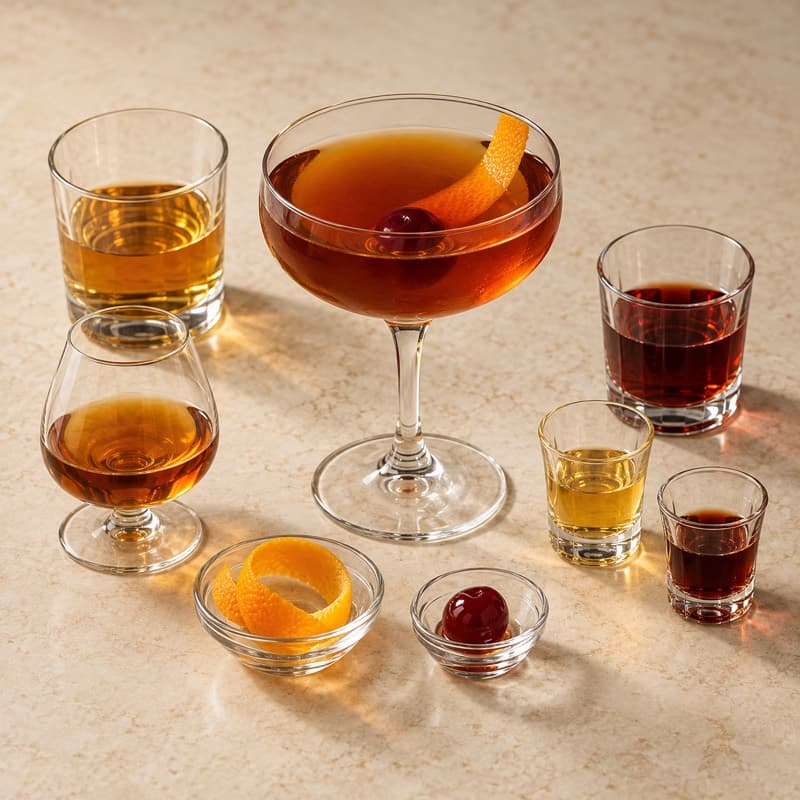
Vieux Carré recipe
1 serving · IBA reference recipeMillilitres control this recipe. US fluid ounces are rounded to the nearest quarter ounce for convenience and are not a different recipe ratio. Dashes, spoons, leaves and other non-liquid measures are listed as written.
| Measure | Ingredient |
|---|---|
| 30 ml≈ 1 US fl oz | rye whiskey |
| 30 ml≈ 1 US fl oz | cognac |
| 30 ml≈ 1 US fl oz | sweet vermouth |
| 1 bar spoon, 5 ml house | Bénédictine |
| 2 dashes | Peychaud’s bitters |
Ice: Cubed ice for stirring only. Garnish: Orange zest and maraschino cherry.
Learning bar service? Continue with the Vieux Carré in module 4 of the free course →
How to make it
- Measure the three 30 ml ingredients into a mixing glass.
- Add the calibrated bar spoon of Bénédictine and bitters.
- Add ice and stir smoothly until chilled.
- Strain without serving ice; finish with zest and cherry.
Why it works: Small liqueur and bitters measures matter because the three-part base already provides considerable flavour.
Common mistakes, useful fixes
Overpowering herbal sweetness
calibrate the spoon.
Mixed specifications
do not automatically add Angostura from another recipe.
Wrong presentation
distinguish the current IBA served-up version from rocks versions.
Serving the guest
What to tell the guest
It has both rye and cognac, balanced with vermouth and a small herbal-liqueur measure.
Dietary and product checks
Vermouth may contain sulphites; check liqueur, bitters and cherry declarations.
Variations
- Rocks service is a separate accepted house presentation with ongoing dilution.
- Recipes using both Angostura and Peychaud’s are distinct from this IBA specification.
Where does the Vieux Carré come from?
Origin: New Orleans, United States; Hotel Monteleone attribution to Walter Bergeron, 1938. (Hotel attribution; exact first-publication chronology not settled here)
Hotel Monteleone credits Walter Bergeron with creating the Vieux Carré in 1938. The name means “old square”, referring to New Orleans’s French Quarter. Present the year as the hotel’s account rather than a final verdict on every historical reference. The recipe offers a particularly useful advanced lesson: rye, cognac and sweet vermouth share the base, while a small herbal-liqueur measure and bitters season it. Multiple familiar ingredients can still produce a confused drink if measured casually. Follow one stated version; do not quietly combine the IBA recipe with another bar’s bitters and rocks presentation.
Vieux Carré questions
Which two spirits form the split base?
Rye whiskey and cognac.
Which bitters are listed in this IBA recipe?
Peychaud’s only.
From a recipe to a repeatable skill
Learn the method behind the order.
Vieux Carré is a required study in Advanced Cocktails & Refined Bar Service, module 4: Aromatics, intense modifiers and split bases. Coordinate split spirits, vermouth, herbal liqueur and bitters.
The course is free. An optional paid certificate tests knowledge in an online exam; it is not an observed practical assessment or an accredited bartending qualification.