
The cocktail notebook · Whiskey
New York Sour
Whiskey sour with red-wine aroma and tannin. A advanced comparison study made by shake and float and strain.
- Base
- rye whiskey or bourbon
- Method
- Shake & Float & Strain
- Glass
- Rocks glass
- Yield
- One drink
Recipe reference: IBA reference recipe. House interprets few drops of egg as a 5 ml pasteurised product trial and selects 1:1 syrup; validate foam before service.
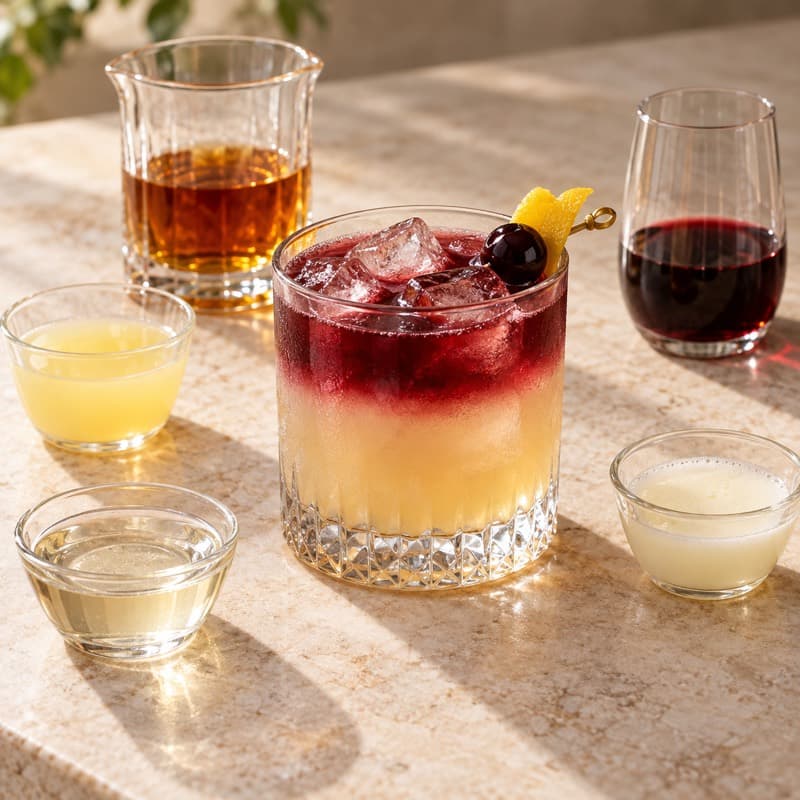
New York Sour recipe
1 serving · IBA reference recipeMillilitres control this recipe. US fluid ounces are rounded to the nearest quarter ounce for convenience and are not a different recipe ratio. Dashes, spoons, leaves and other non-liquid measures are listed as written.
| Measure | Ingredient |
|---|---|
| 60 ml≈ 2 US fl oz | rye whiskey or bourbon |
| 22.5 ml≈ 0.75 US fl oz | simple syrup, 1:1 by mass |
| 30 ml≈ 1 US fl oz | fresh lemon juice |
| 5 ml≈ 0.25 US fl oz | approved pasteurised liquid egg white, house trial |
| 15 ml≈ 0.5 US fl oz | red wine, Shiraz or Malbec |
Ice: Fresh cubed serving ice. Garnish: 1 lemon zest and 1 cocktail cherry.
Learning bar service? Continue with the New York Sour in module 5 of the free course →
How to make it
- Keep the red wine separate and prepare approved pasteurised egg handling.
- Shake whiskey, lemon, syrup and egg white with ice.
- Strain onto fresh ice in a chilled rocks glass.
- Float the measured wine gently over the back of a spoon and apply garnish.
Why it works: Reserve red wine for the finish. The source’s all-ingredients wording is read alongside its explicit instruction to float wine after straining.
Common mistakes, useful fixes
Unrecorded substitution
Offer a disclosed, tested egg-free variation and follow cross-contact procedures.
Inconsistent finish
check the exact measures, products and preparation sequence.
Unclear guest expectation
explain this specification before preparing.
Serving the guest
What to tell the guest
Whiskey sour with red-wine aroma and tannin. Offer a disclosed, tested egg-free variation and follow cross-contact procedures.
Dietary and product checks
Contains egg; use approved pasteurised product and allergen controls. Check all exact product labels and relevant guest restrictions; no generic recipe guarantees safety.
Variations
- Any variant must be named and recorded. Offer a disclosed, tested egg-free variation and follow cross-contact procedures.
Where does the New York Sour come from?
Origin: Origin not yet verified in this edition. (Origin not yet verified in this edition)
The cited IBA page establishes this modern reference recipe, not a definitive country, inventor or date. This lesson keeps those historical questions open rather than repeating an unsupported origin tale. Its learning purpose is specific: Reserve red wine for the finish. The source’s all-ingredients wording is read alongside its explicit instruction to float wine after straining.
New York Sour questions
What is the key decision in this study?
Reserve red wine for the finish. The source’s all-ingredients wording is read alongside its explicit instruction to float wine after straining.
The guest asks for egg-free preparation.
Offer a disclosed, tested egg-free variation and follow cross-contact procedures.
From a recipe to a repeatable skill
Learn the method behind the order.
New York Sour is a required study in Advanced Cocktails & Refined Bar Service, module 5: Texture and operational feasibility. Control a wine float and explain how wine choice affects the sour.
The course is free. An optional paid certificate tests knowledge in an online exam; it is not an observed practical assessment or an accredited bartending qualification.