
The cocktail notebook · Gin · Wine & aperitif
French 75
Bright lemon, gin botanicals and fine sparkling-wine character. A sparkling sour made by shake and strain.
- Base
- Gin + Champagne in our reference; venue cognac variants exist
- Method
- Shake & Strain
- Glass
- Chilled Champagne flute
- Yield
- One drink
Recipe reference: IBA reference recipe. IBA leaves sugar syrup concentration undefined; house uses 1:1 by mass.
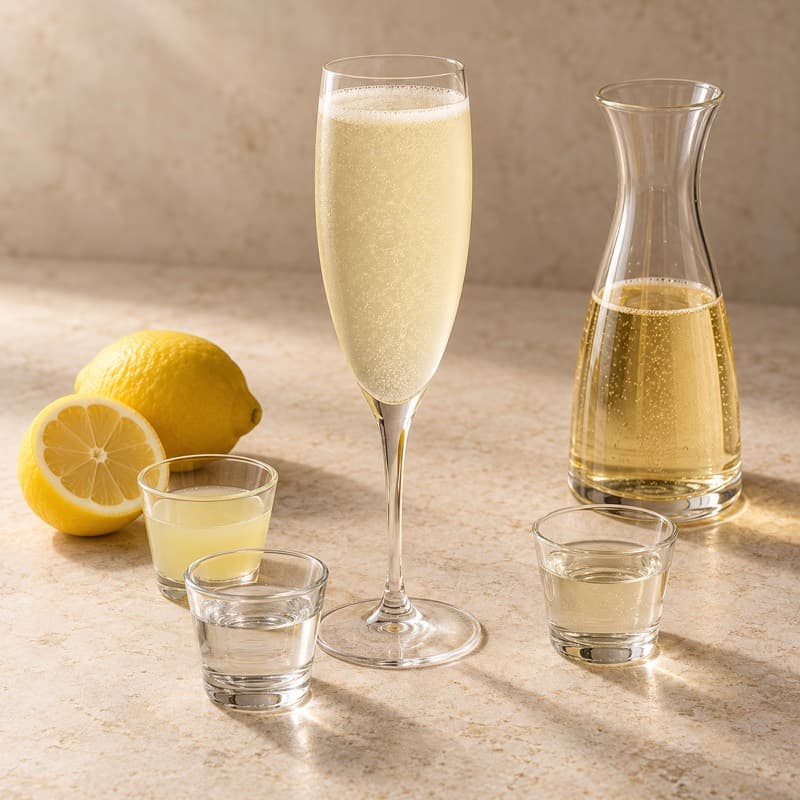
French 75 recipe
1 serving · IBA reference recipeMillilitres control this recipe. US fluid ounces are rounded to the nearest quarter ounce for convenience and are not a different recipe ratio. Dashes, spoons, leaves and other non-liquid measures are listed as written.
| Measure | Ingredient |
|---|---|
| 30 ml≈ 1 US fl oz | gin |
| 15 ml≈ 0.5 US fl oz | fresh lemon juice |
| 15 ml≈ 0.5 US fl oz | simple syrup, 1:1 by mass |
| 60 ml≈ 2 US fl oz | chilled Champagne |
Ice: Cubed ice for shaking the still components only. Garnish: None in the IBA reference.
Learning bar service? Continue with the French 75 in module 7 of the free course →
How to make it
- Chill the flute and check the Champagne before mixing.
- Shake gin, lemon and syrup with cubed ice until cold.
- Strain into the flute; slowly add 60 ml Champagne.
- Lift gently once if needed and serve without ice.
Why it works: Separating the carbonated component protects pressure control and bubbles while properly chilling the citrus mixture.
Common mistakes, useful fixes
Foam overflow
pour Champagne slowly into a chilled glass.
Flat
never shake the sparkling wine.
Too sweet
check syrup concentration and wine style.
Serving the guest
What to tell the guest
It combines a gin-and-lemon sour with Champagne added at the finish.
Dietary and product checks
Champagne may contain sulphites. Check ingredients and avoid unsupported strength descriptions.
Variations
- Cognac versions have their own historical and house specifications.
- Other sparkling wine creates a sparkling-wine variation; name it honestly rather than claiming Champagne.
Where does the French 75 come from?
Origin: French-associated name and early-20th-century repertoire; precise inventor disputed. (1930 printed Champagne version verified)
The French 75 has earlier names and recipes that do not all match the modern sparkling drink. A useful dated reference is Harry Craddock’s 1930 Savoy Cocktail Book, which prints gin, lemon, sugar and Champagne. It establishes that combination without proving a unique inventor or a precise founding scene. The name is traditionally associated with the French 75 mm field gun; present that as the naming tradition. The service lesson is more immediate: shake the still sour component first, then add Champagne. Combining those tasks in a sealed shaker is both incorrect and unnecessary.
French 75 questions
Which ingredient stays out of the shaker?
Champagne.
Is garnish required in this reference?
No.
From a recipe to a repeatable skill
Learn the method behind the order.
French 75 is a required study in Advanced Cocktails & Refined Bar Service, module 7: Sparkling integration and refined delivery. Integrate a shaken base with sparkling wine without shaking carbonation.
The course is free. An optional paid certificate tests knowledge in an online exam; it is not an observed practical assessment or an accredited bartending qualification.