Hospitality English certificate for Gulf and Middle East hotel jobs: what employers verify
Gulf 5-star hotels run the toughest English screenings in hospitality. Here is what they test, how a certificate shows readiness, and what employers verify.
Key Takeaways at a Glance
Hiring Volume
Over 100,000 luxury keys opening in GCC (STR 2024)
Screening Ratio
Over 400 applicants per entry front desk role
Language Standard
5-Star Brand Operational English & Etiquette
Verification Method
Instant Online Credential Lookup (HC-2026-XXXXXXXX)
- 1.The luxury hospitality landscape across Dubai, Abu Dhabi, Doha, and Riyadh
- 2.The 400-to-1 screening funnel: how Gulf hotel recruiters filter applications
- 3.What Gulf HR directors actually evaluate in pre-screening phone calls
- 4.Luxury brand communication standards: replacing informal speech with 5-star vocabulary
- 5.High-stakes role-plays: resolving VIP guest complaints under pressure
- 6.Why general language tests fail to prove hospitality readiness
- 7.How cross-border credential verification streamlines visa sponsorship approvals
- 8.Validate your hospitality English with an internationally verifiable credential
The luxury hospitality landscape across Dubai, Abu Dhabi, Doha, and Riyadh
The Gulf Cooperation Council (GCC) countries are experiencing an unprecedented hospitality construction and recruitment boom. Driven by Saudi Vision 2030 megaprojects, Dubai's continuous tourism expansion, and Qatar's post-World Cup leisure market, international hospitality brands are opening hundreds of ultra-luxury properties across the region.
According to the STR Middle East Hotel Pipeline Report 2024/2025, over 100,000 new luxury and upscale hotel rooms are actively under construction across the Arabian Gulf. Because local populations in the Gulf are relatively small, these properties depend on international staffing for over 90 percent of their guest-facing operational workforce.
However, working in a 5-star property in Dubai, Doha, or Riyadh is not an ordinary hotel job. Ultra-high-net-worth international travelers, corporate executives, and royal delegations expect flawless service execution. For these properties, professional English is the universal operating language connecting an international staff to a global guest clientele.
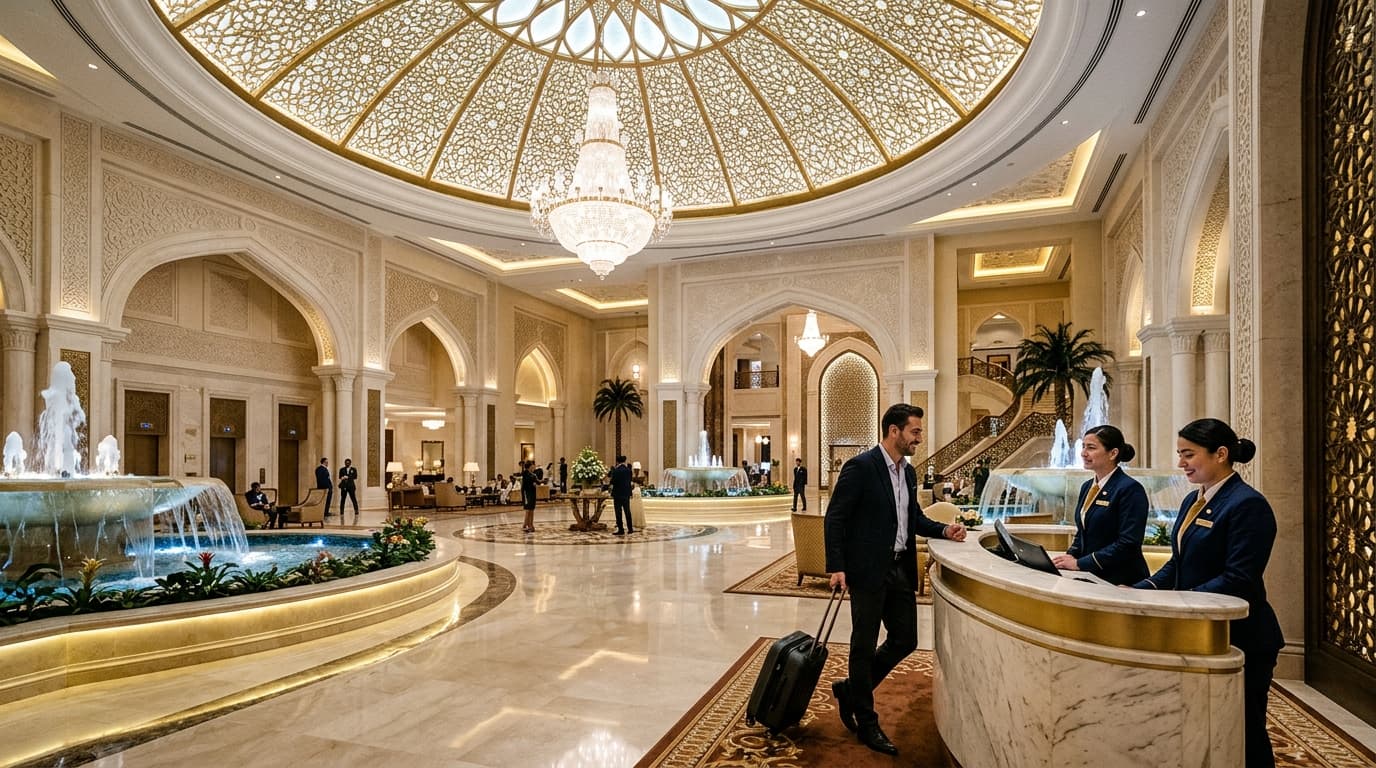
The 400-to-1 screening funnel: how Gulf hotel recruiters filter applications
Because Gulf hospitality jobs offer full visa sponsorship, furnished staff accommodation, duty meals, and tax-free salaries, job postings attract an overwhelming volume of international candidates. A single entry-level opening for a Front Desk Agent or Food & Beverage Host at a branded 5-star resort routinely receives 300 to 500 applications within forty-eight hours.
Human resources teams based in Dubai or Abu Dhabi manage this deluge by using automated Applicant Tracking Systems (ATS) configured to enforce strict initial screening filters. Applications that lack certified qualifications in hospitality operations or international English communication are filtered out automatically before recruiter review.
According to the Gulf Hospitality Workforce Report 2024, recruitment managers eliminate over 75 percent of applications in the first screening round because candidates provide generic resumes without verifiable proof of English language readiness. Documenting verified qualifications is the only reliable way to break through this initial filter.
What Gulf HR directors actually evaluate in pre-screening phone calls
If your application clears the initial resume screening, the next hurdle is an unannounced 10-minute video or telephone screening call conducted by a talent acquisition specialist. In this conversation, the recruiter is not testing factual trivia; they are evaluating your vocal clarity, your accent comprehensibility, and your conversational poise.
Recruiters listen intently for verbal confidence. If a candidate hesitates, speaks in flat monosyllables, or repeatedly asks the interviewer to repeat standard questions, the call ends quickly. In a luxury lobby where room rates exceed $800 per night, staff must communicate with effortless warmth and clarity.
The interviewer will typically initiate a scenario role-play: 'An arriving guest is frustrated because their ocean-view suite is undergoing maintenance. How do you welcome them and handle the delay?' Candidates who possess structured Hospitality English training respond smoothly using proven de-escalation scripts.
Luxury brand communication standards: replacing informal speech with 5-star vocabulary
In premier properties managed by brands like Ritz-Carlton, Four Seasons, Jumeirah, St. Regis, or Mandarin Oriental, casual conversational English is strictly prohibited on the floor. Standard everyday phrases are replaced with formal luxury service vocabulary.
Untrained candidates frequently say 'No problem,' 'Hold on a second,' or 'I don't know.' In luxury hospitality standards, these casual phrases are considered unprofessional. Staff are trained to replace them with elevated phrasing: 'It is my absolute pleasure,' 'Allow me a brief moment to confirm that for you, Sir,' and 'Allow me to personally find the answer for you immediately.'
Furthermore, addressing guests by their surname at least twice during an interaction without checking the register repeatedly is a mandatory brand audit benchmark. Learning this specialized vocabulary before applying demonstrates that you are culturally prepared for luxury operations.
High-stakes role-plays: resolving VIP guest complaints under pressure
In the Gulf luxury market, service recovery is a critical managerial competency. High-spending international travelers often hold demanding service expectations, and unexpected delays or minor room imperfections can escalate rapidly if not handled with exceptional emotional intelligence.
During final-round interviews with the Director of Front Office or Food & Beverage Manager, candidates are tested on the LAST protocol: Listen actively without defensive interruption, Apologize sincerely for the inconvenience, Solve the problem proactively with concrete alternatives, and Thank the guest for bringing the matter to management's attention.
Demonstrating that you can execute this protocol fluently in English — maintaining a calm posture, gentle eye contact, and soothing vocal tone — proves to the hiring manager that you will protect the hotel's brand reputation during difficult service moments.
Why general language tests fail to prove hospitality readiness
Many candidates submit academic English test scores, such as IELTS or TOEFL, believing these certificates guarantee hiring success. While an IELTS score proves academic reading and writing ability, Gulf hotel general managers recognize that it does not evaluate vocational service reflexes.
An applicant with an academic language band may write flawless research essays, yet stumble when required to explain the ingredients of a complex Arabic mezze platter or guide an arriving guest through electronic room controls. Academic tests simply do not evaluate hospitality-specific vocabulary or guest service cadence.
Gulf recruiters actively seek specialized hospitality certifications that evaluate the exact dialogues of luxury accommodation: check-in scripts, dining sequences, telephone reservations, and complaint de-escalation. These focused credentials confirm operational readiness.
How cross-border credential verification streamlines visa sponsorship approvals
Recruiting a foreign employee involves strict administrative compliance. In jurisdictions like the UAE, Qatar, and Saudi Arabia, hotel human resources departments must submit documentation to labor ministries and immigration authorities to obtain employment visa quotas.
Submitting candidate profiles backed by verifiable vocational qualifications accelerates corporate internal approvals. When HR managers present an applicant profile featuring an authenticated credential from an established vocational registry, the hiring dossier moves through corporate executive sign-offs without administrative delays.
A credential verified instantly online via a central registry provides the documentation needed to prove the foreign hire possesses legitimate vocational preparation for the sponsored role.
Free Course
Hospitality English
Learn to measure and reduce your OTA dependency — free modules, verifiable certificate.
Validate your hospitality English with an internationally verifiable credential
If you are targeting lucrative luxury hotel opportunities across Dubai, Abu Dhabi, Doha, or Riyadh, mastering professional hospitality English is your essential prerequisite. Hospitality Certificate provides a comprehensive Hospitality English course that is 100 percent free to study online, covering luxury arrival welcomes, dining service dialogues, telephone reservations, and complaint de-escalation.
At the conclusion of the course, an objective assessment requiring a 75% passing threshold validates your communication capabilities. If you do not pass on your first attempt, you benefit from free unlimited retakes to study the modules and repeat the test at no cost. Once you achieve 75% or higher, your official instant certificate can be claimed for an issuance fee of only €7.99.
Every credential includes a unique certificate ID (HC-2026-XXXXXXXX) recorded in our public verification database. Gulf hotel recruiters and HR directors can verify your qualification instantly on our public verification page at hospitalitycertificate.com/verify without login hurdles. Adding this employer-verifiable certificate to your CV gives you the competitive edge needed to secure 5-star hotel interviews and international visa sponsorship.
Hospitality English
The English you actually use on shift — free to learn. Access all study modules free, then take the exam to earn your certificate.