Free hotel certificate recognized by employers: what actually makes one credible
Not all free online hospitality certificates are equal. Here is what hotel hiring managers check for and what separates real credentials from PDFs.
Key Takeaways at a Glance
Verification Method
Live Public Database vs Static PDF
Employer Access
Zero-Login Public Registry Search
Credential Format
Unique Alphanumeric Code (HC-2026-XXXXXXXX)
Audit Standard
75% Minimum Exam Mastery Threshold
- 1.The proliferation of digital certificates in hospitality recruitment
- 2.The three tiers of digital credentials: from decorative PDFs to public registries
- 3.Why hotel HR teams distrust unverified PDF certificates
- 4.The technical architecture of employer verification
- 5.The role of objective assessment: why a 75% pass mark matters
- 6.How to present a verifiable credential to an applicant tracking system
- 7.What hiring managers see during a 30-second verification check
- 8.Earn a verifiable front desk certificate with public validation
The proliferation of digital certificates in hospitality recruitment
The internet is filled with thousands of websites offering hospitality credentials, ranging from free attendance certificates to expensive diploma programs. For an aspiring hotel worker looking to bolster their CV, finding an option that hotel employers actually value is a confusing challenge. Many job seekers invest hours into online modules, only to discover their certificate is dismissed by hiring managers upon submission.
Hotel recruiters and human resources directors review hundreds of resumes every week. When they scan an applicant's education and certifications section, they look for specific indicators of legitimacy. They must ensure that the stated credential represents verified technical competence rather than an unearned participation badge purchased or downloaded with zero oversight.
According to the Society for Human Resource Management (SHRM) 2024 Credential Verification & Resume Fraud Survey, over 40 percent of job applications contain fabricated or unverifiable professional credentials. As a result, corporate hotel operators and independent luxury resorts have implemented strict vetting protocols to separate decorative PDFs from authentic vocational qualifications.
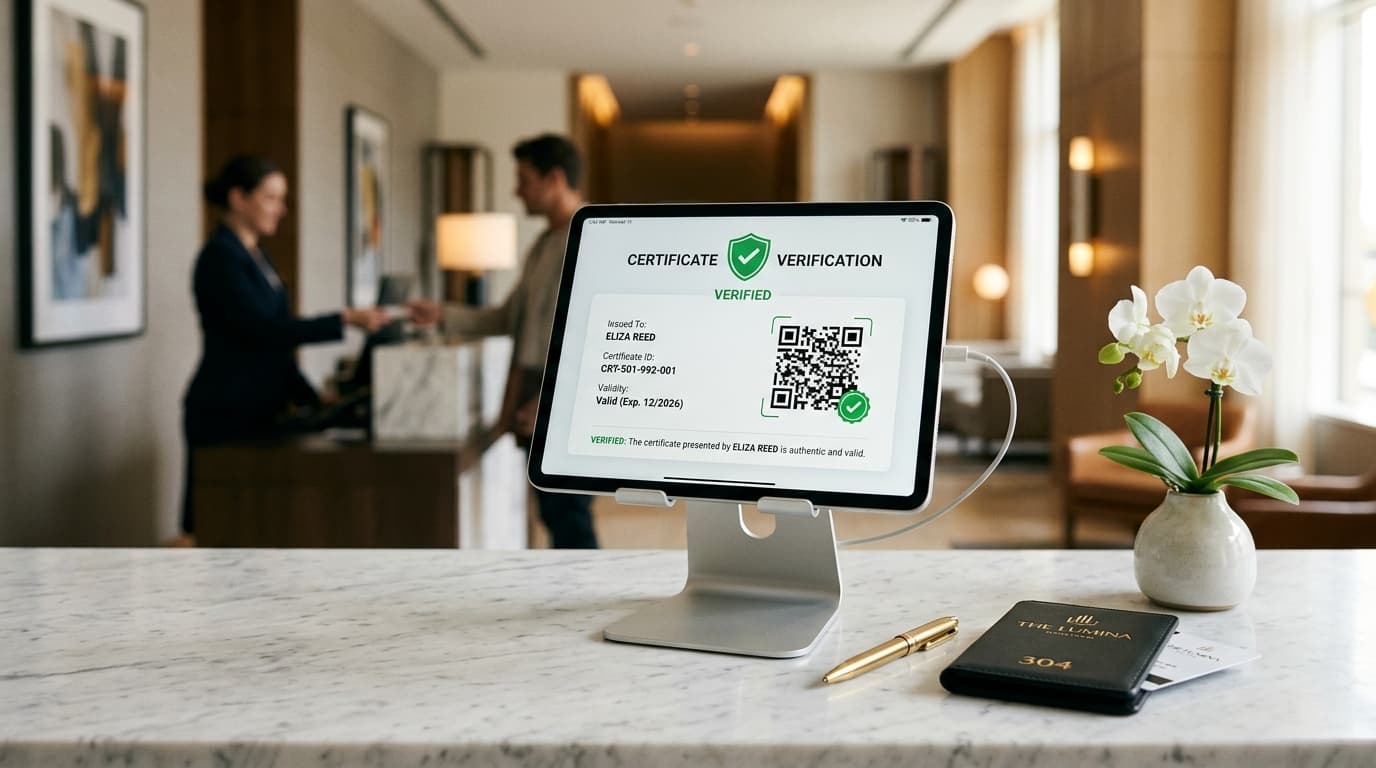
The three tiers of digital credentials: from decorative PDFs to public registries
To understand what makes a certificate credible to an employer, job seekers must understand the three distinct technical tiers of digital credentials currently circulating online.
Tier 1 consists of static downloadable PDFs. These documents display the candidate's name alongside an ornamental border, but contain no database identifier, no verification URL, and no verifiable exam record. Because anyone with basic graphic design software can produce an identical document in minutes, recruiters treat static PDFs with high skepticism and rarely consider them evidence of genuine training.
Tier 2 includes certificates with static QR codes that merely resolve to an image file of the same document, offering little added security. Tier 3, by contrast, represents live database registries. A Tier 3 credential provides an employer-verifiable record tied to a central public verification database, allowing employers to confirm passing dates, course curriculum, and student identity with absolute certainty.
Why hotel HR teams distrust unverified PDF certificates
When a candidate submits a PDF certificate without an independent verification link, they force the recruiter to make an unverified assumption of honesty. In a high-liability industry like hospitality — where staff handle confidential guest payment data, emergency room keys, and health safety procedures — recruiters cannot afford to rely on unverified assumptions.
Traditional verification methods require a recruiter to email or telephone the issuing institution, ask for the registrar, and wait days for a response. In fast-paced hotel hiring environments where seasonal positions must be filled in 48 hours, hiring managers simply will not make that administrative effort. Unverified credentials are routinely skipped.
An employer-verifiable credential eliminates this operational barrier entirely. When a resume features a direct link to an open verification database, the hiring manager can confirm the credential's authenticity in under fifteen seconds during their initial resume scan.
The technical architecture of employer verification
What makes a vocational certificate truly credible to an employer is the presence of an open, public verification page. A secure verification architecture relies on three primary technical components: a unique certificate ID, an open query interface, and tamper-proof database archiving.
Every credential issued must carry an immutable alphanumeric identifier, such as the standard HC-2026-XXXXXXXX pattern. When entered into the issuing platform's verification portal, the system queries the central ledger and displays the verified candidate name, the specific course completed, the date of examination, and the validity status.
Crucially, the verification system must operate with zero friction for the employer. If a recruiter is forced to create an account, enter corporate tax IDs, or pay a fee to verify an applicant's claim, they will abandon the process. An open public verification page allows anyone with the credential code to confirm the record instantly.
The role of objective assessment: why a 75% pass mark matters
A certificate is only as credible as the assessment required to earn it. Programs that award certificates merely for letting video lectures run in a background browser tab provide zero assurance of vocational competence. Employers recognize these attendance badges and place virtually no hiring value on them.
To earn employer recognition, a certification program must test practical application through rigorous scenario-based assessments. Questions must evaluate real-world decision-making: how to respond to an overbooked arrival, how to correct a folio billing error, or how to de-escalate a confrontation with an dissatisfied guest.
Requiring a strict 75% passing threshold ensures that only candidates who thoroughly comprehend operational procedures receive certification. When a hotel manager sees a credential backed by a 75% mastery standard, they know the candidate has demonstrated real operational capability.
How to present a verifiable credential to an applicant tracking system
Formatting your credential correctly on your CV is critical for passing both automated Applicant Tracking Systems (ATS) and manual recruiter reviews. An ATS does not read graphic seals or embedded PDF signatures; it parses raw text lines.
Under your CV's 'Certifications' section, list your credential using standardized formatting: 'Front Desk & Reception Specialist · Hospitality Certificate · Issued Sept 2026 · Credential ID: HC-2026-XXXXXXXX · Verify at hospitalitycertificate.com/verify'. Beneath this entry, add concise bullet points outlining the specific skills mastered.
This format ensures that when the ATS scans your resume, it indexes both the industry keywords (such as PMS, reservations, and check-in) and the verification link. When the hiring manager opens your file, the presence of the live URL immediately validates your training.
What hiring managers see during a 30-second verification check
Understanding the employer's verification experience clarifies why this feature is so impactful. When a recruiter clicks your verification link or navigates to hospitalitycertificate.com/verify and enters your unique certificate ID, they are presented with a clean, branded verification summary.
The verification page confirms the recipient's legal name, the exact qualification completed, the official date of issue, and the core competencies evaluated during the examination. This independent third-party confirmation provides immediate peace of mind.
In competitive hiring pools where twenty applicants present similar work backgrounds, the candidate whose credentials can be independently confirmed without paperwork or phone calls consistently moves to the top of the interview shortlist.
Free Course
Front Desk & Reception
Learn to measure and reduce your OTA dependency — free modules, verifiable certificate.
Earn a verifiable front desk certificate with public validation
If you are seeking a credible credential to accelerate your hospitality career, Hospitality Certificate offers an industry-aligned Front Desk & Reception course that is completely free to study online. The program covers Property Management Systems, guest registration, financial reconciliation, and communication standards.
The course concludes with an online examination requiring a 75% passing threshold to prove your mastery. You benefit from free unlimited retakes, allowing you to study and repeat the assessment as many times as necessary without cost. Once you pass with 75% or higher, your official instant certificate can be claimed for an issuance fee of only €7.99.
Each credential includes a unique certificate ID formatted as HC-2026-XXXXXXXX, permanently archived in our public verification database. Employers can verify your qualification at any time on our public verification page at hospitalitycertificate.com/verify with zero login barriers. Adding this employer-verifiable certificate to your CV provides concrete proof of competence that commands recruiter confidence.
Front Desk & Reception
Check-ins, bookings, payments, and problems — free to learn. Access all study modules free, then take the exam to earn your certificate.