
Do Employers Accept Online Certificates?
How hiring managers evaluate online skill credentials, what a certificate proves on your CV, and the real difference between skills and state licenses.
Key Takeaways at a Glance
Credential Type
Tested Skill Verification
Employer Value
Proves proactive initiative
Verification
Unique ID & Server Grading
Legal Status
Skills proof (Non-regulated)
If you are considering earning an online hospitality certificate to boost your CV, you likely have one essential question: Will a hotel manager, restaurant owner, or recruiter actually value this credential when deciding whether to interview or hire me?
The honest answer requires cutting through marketing hype and examining how hiring managers in the service industry evaluate job applications.
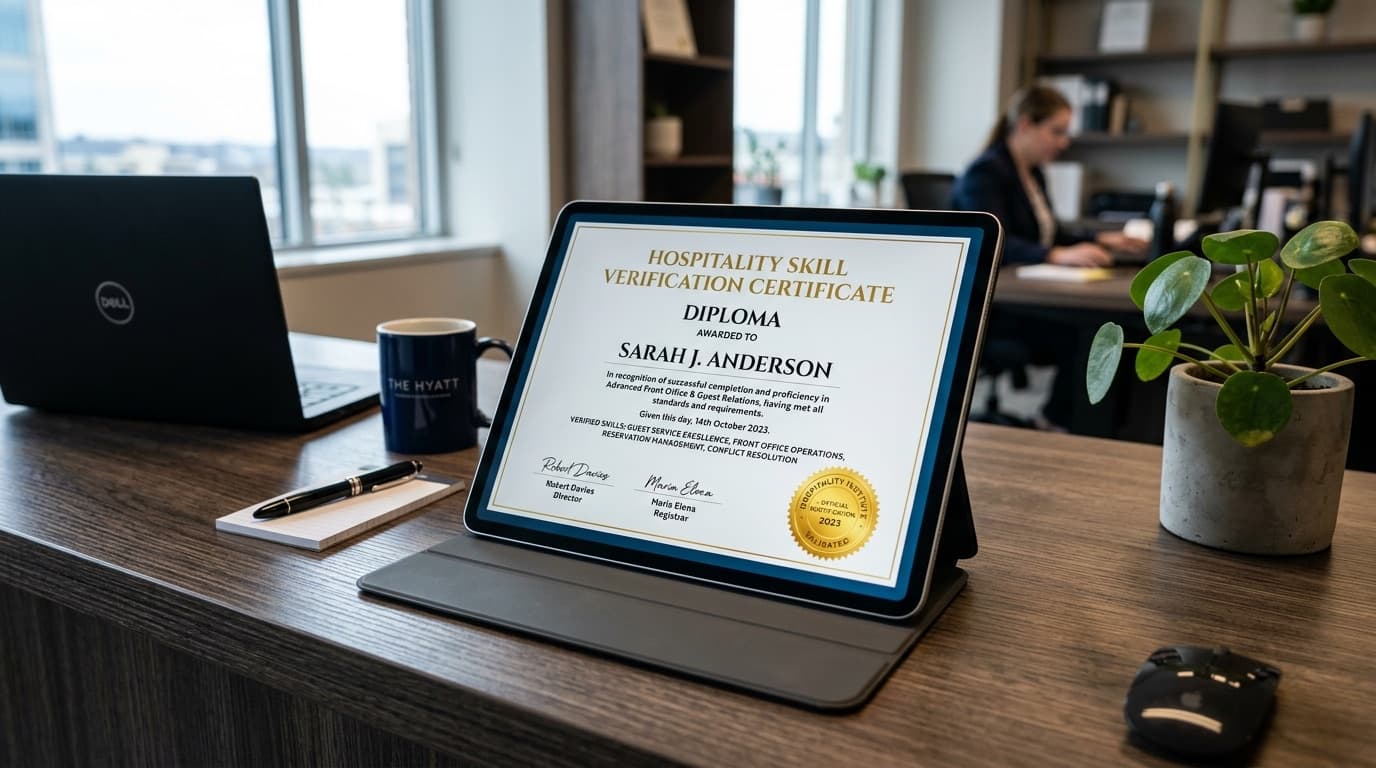
The distinction between skill credentials and state licenses
To understand how employers view online certificates, it is essential to distinguish between legally mandated government licenses and voluntary skill credentials.
Legally mandated qualifications — such as official HACCP food safety certificates in Europe or state alcohol service licenses in North America — are mandatory legal prerequisites for specific roles. Online skill certificates do not replace regulated government licenses, and legitimate providers never claim they do.
An online hospitality certificate is a skill credential. It serves as objective, tested evidence that you have studied standard operational procedures, mastered job-specific terminology, and passed a structured evaluation under your own name.
Why hotel and restaurant managers value skill verification
Hospitality recruiters review dozens of CVs for every open position. Most entry-level applications look identical: a list of generic claims such as 'hardworking', 'fast learner', or 'great team player'.
An online skill certificate breaks through this noise by providing concrete proof of proactive effort and tested knowledge. When a recruiter sees a verifiable certificate on your application, it tells them three specific things:

- Proactive Initiative: You took personal responsibility to prepare for the role before being paid to do so.
- Operational Baseline: You already understand core workflows (such as table service sequence, check-in logic, or guest communication rules), reducing on-the-job training time.
- Verifiable Authenticity: A certificate backed by a unique online verification ID allows the employer to confirm your score, date, and identity instantly.
What makes a certificate credible to an employer
Not all online certificates carry equal weight. Hiring managers dismiss digital badges that are awarded simply for watching videos or paying a fee without rigorous testing.
For a credential to carry credibility, it must feature server-graded examination standards, random question sampling, anti-cheat validation, and a public verification lookup page.
Verification Standard
Every Hospitality Certificate is backed by a 20-question server-graded exam sampled from a 30-question bank, requiring a 75% passing threshold. Certificates feature a unique ID that employers can verify online at any time.
How to feature online credentials on your CV and LinkedIn
To maximize the impact of your online certificate, present it clearly under a dedicated 'Certifications & Training' section on your CV.
Include the exact title of the credential, the issuing network, your completion date, and your unique verification URL or ID. On LinkedIn, add the credential under the 'Licenses & Certifications' section to ensure it appears in recruiter search queries for hospitality skills.