
The cocktail notebook · Rum & cane spirit
Caipirinha
Fresh lime, sugar and cachaça character. A muddled lime drink made by stir.
- Base
- Brazilian sugar-cane spirit; keep distinct in teaching
- Method
- Stir
- Glass
- Double old fashioned glass
- Yield
- One drink
Recipe reference: IBA reference recipe. Level 5 ml teaspoons are the house convention. Whole-fruit juice yield is unmeasured; the diagram includes only the 60 ml measured spirit and is not a complete composition estimate.
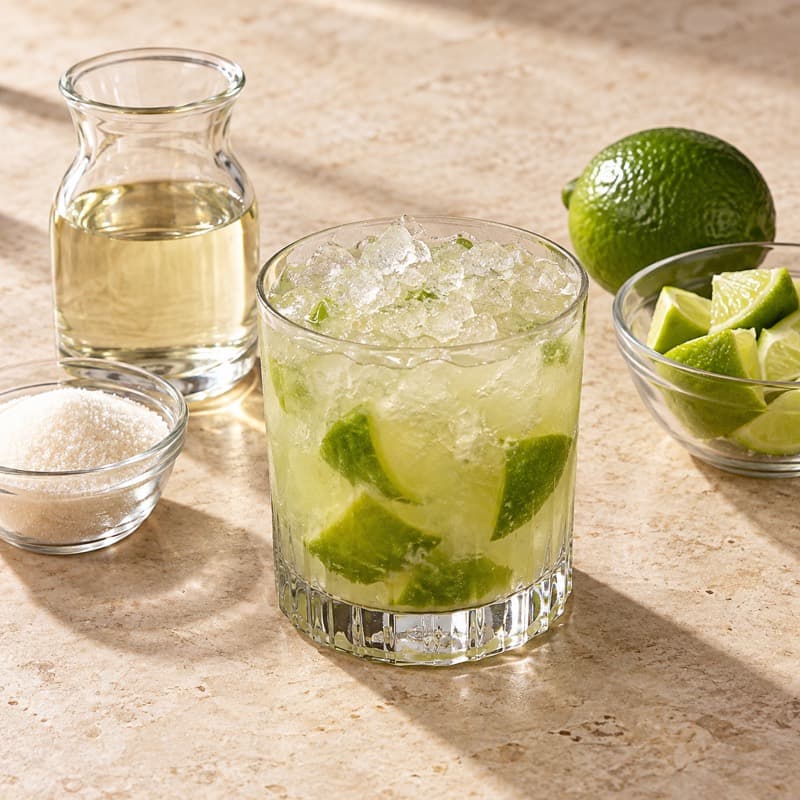
Caipirinha recipe
1 serving · IBA reference recipeMillilitres control this recipe. US fluid ounces are rounded to the nearest quarter ounce for convenience and are not a different recipe ratio. Dashes, spoons, leaves and other non-liquid measures are listed as written.
| Measure | Ingredient |
|---|---|
| 60 ml≈ 2 US fl oz | cachaça |
| 1 whole lime | cut into small wedges |
| 4 level teaspoons | white cane sugar |
Ice: Cracked ice. Garnish: None beyond recipe lime.
Learning bar service? Continue with the Caipirinha in module 4 of the free course →
How to make it
- Wash and cut one sound lime into small wedges.
- Place lime and sugar in the glass; press gently to release juice without grinding peel.
- Add cracked ice and measured cachaça.
- Stir gently through the glass to distribute sugar and juice.
Why it works: The lime is measured as a whole fruit, so its extracted juice volume is unknown. A liquid percentage chart cannot treat it as a known ml amount.
Common mistakes, useful fixes
Bitter peel
avoid crushing aggressively.
Gritty sugar
distribute it carefully.
Wrong base
rum and vodka versions have different identities.
Serving the guest
What to tell the guest
Fresh lime, sugar and cachaça character. The lime is measured as a whole fruit, so its extracted juice volume is unknown. A liquid percentage chart cannot treat it as a known ml amount.
Dietary and product checks
Check exact products, declared allergens and cross-contact controls before service.
Variations
- Any adaptation needs a recorded recipe and an honest description. Confirm the variation; the IBA calls the vodka version a Caipiroska.
Where does the Caipirinha come from?
Origin: Brazilian cultural association; precise inventor and creation date not established here. (Attributed venue/creator account or documented cultural context; limits stated)
Brazil’s national statistics agency, IBGE, describes caipirinha as a typically Brazilian drink and cachaça as its principal ingredient. That supports the national association without establishing one inventor or creation date. Our record does not repeat medicinal origin legends as verified history. The preparation lesson focuses on cachaça, whole-lime extraction, sugar dissolution and measured spirit.
Caipirinha questions
Can we calculate lime percentage from one whole lime?
No. The actual extracted juice must be measured first.
What preparation detail matters for this order?
The lime is measured as a whole fruit, so its extracted juice volume is unknown. A liquid percentage chart cannot treat it as a known ml amount.
From a recipe to a repeatable skill
Learn the method behind the order.
Caipirinha is a required study in Essential Cocktails & Bar Foundations, module 4: Fresh ingredients and finishing. Muddle whole lime and dissolve sugar; explain why juice yield prevents a complete volume percentage.
The course is free. An optional paid certificate tests knowledge in an online exam; it is not an observed practical assessment or an accredited bartending qualification.