GEO for Hotels: Get Found by AI
A practical guide to Generative Engine Optimization for independent hotels. Win citations in ChatGPT, Perplexity, and AI search with structured schema data.
Key Takeaways at a Glance
Travelers Using AI for Planning
33% - 40% (Phocuswright)
Complete Hotel Schema Adoption
<11% of Properties (Industry Audit)
GEO Citation Visibility Uplift
+30% - +40% (Aggarwal et al.)
Cost of Paid AI Placement
€0 (Unpaid Algorithmic Citation)
- 1.The shift from ten blue links to conversational AI answers
- 2.How LLMs evaluate and select hotels to recommend
- 3.The three critical factors that make an independent hotel invisible to AI
- 4.Schema markup: the machine-readable language of AI search
- 5.Content architecture: the exact pages AI engines read first
- 6.Reputational consistency across the web
- 7.What does NOT work: black-hat AI SEO tactics to avoid
- 8.Future-proofing your hotel distribution for the AI era
The shift from ten blue links to conversational AI answers
For twenty-five years, hotel search engine optimization followed a familiar playbook: target keywords like 'boutique hotel in Florence', build backlinks, write keyword-rich meta descriptions, and compete for rank on Google's list of blue links. Today, consumer search habits are undergoing the most significant transformation since the invention of the web.
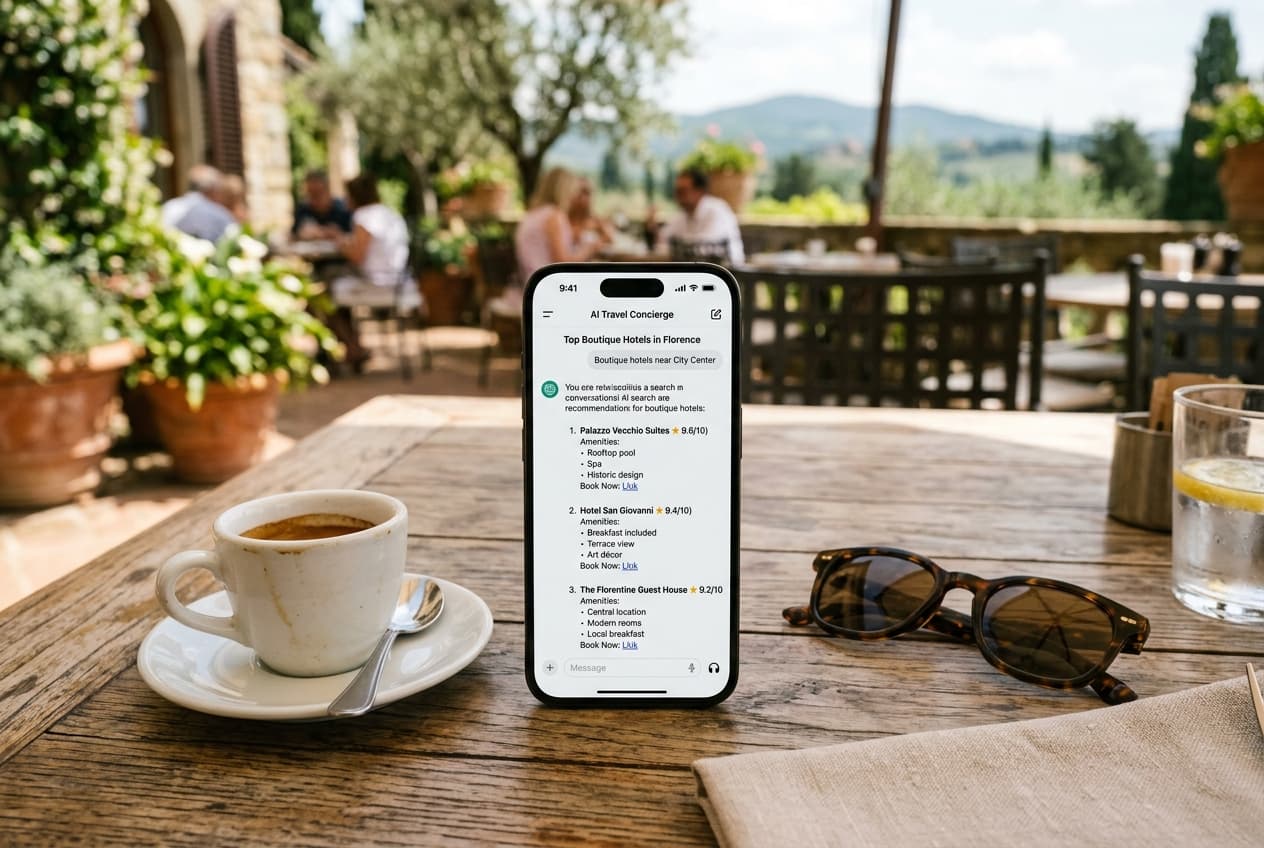
Millions of travelers are bypassing traditional search result pages entirely. Instead of searching keywords, they prompt conversational AI engines like ChatGPT, Google AI Overviews, Perplexity, and Claude with complex, multi-variable requests: 'We are traveling to Seville for four nights in October with a baby. Find us a quiet, historic boutique hotel within walking distance of the cathedral, with an elevator, reliable air conditioning, and on-site breakfast under €220 a night.'
In response, the AI does not provide a list of ten travel agency links; it generates a curated recommendation of two or three specific properties. First defined in 2023 by researchers from Princeton University, Georgia Tech, and the Allen Institute for AI, Generative Engine Optimization (GEO) demonstrates that structuring web content with authoritative facts, statistics, and unambiguous entity definitions can boost AI visibility by 30% to 40%.
How LLMs evaluate and select hotels to recommend
Large language models and real-time retrieval systems do not evaluate websites like human travel agents. They synthesize answers by cross-referencing information across hundreds of web sources to verify entity authority, factual consistency, and contextual relevance.
When an AI evaluates whether to recommend your property for a specific traveler prompt, it checks for three critical signals:
- Entity Clarity: Does the model recognize your hotel as an unambiguous real-world entity with a verified address, geo-coordinates, and operational status?
- Fact Verification: Are your stated amenities (e.g., heated rooftop pool, pet policy, EV charging) confirmed across independent third-party sources like Google Business Profile, TripAdvisor, and local tourism databases?
- Sentiment & Consensus: What is the collective consensus across guest reviews regarding service quality, cleanliness, and location convenience?
The three critical factors that make an independent hotel invisible to AI
Most independent hotels are completely invisible to generative AI search engines for three specific operational reasons:
First, lack of structured data markup. If your website relies entirely on unstructured creative prose ('Our tranquil sanctuary nestled amidst historic cobblestones'), AI crawlers struggle to extract concrete facts like room count, check-in times, or elevator access.
Second, conflicting information across web directories. If your website says check-out is at 11:00 AM, but your TripAdvisor profile states 10:30 AM and your Booking.com listing says 12:00 PM, AI algorithms detect a factual conflict and lower their recommendation confidence score.
Third, blocking AI search bot crawlers in robots.txt. Many hotel web developers inadvertently disallow modern search agents like GPTBot, ClaudeBot, and PerplexityBot, preventing AI models from indexing the property's latest room rates and direct booking perks.
Robots.txt AI Crawling Check
Ensure your robots.txt file does not disallow GPTBot, ClaudeBot, or PerplexityBot from crawling public room and amenity pages. Blocking them guarantees your property will never be cited in conversational search results.
Schema markup: the machine-readable language of AI search
The single highest-leverage technical step you can take for GEO is implementing comprehensive Schema.org JSON-LD structured data on your website. Schema is a standardized code format that resides in the background of your web pages, translating your hotel's details into unambiguous machine-readable data.
Your developer should implement full JSON-LD markup for the 'Hotel' schema type, including these crucial properties:
- @type: 'Hotel' with precise legal name, official URL, telephone, and full postalAddress.
- geo: Latitude and longitude coordinates accurate to within five meters.
- amenityFeature: Explicit boolean declarations for amenities (e.g., 'petsAllowed': true, 'hasWiFi': true, 'hasElevator': true).
- priceRange: Accurate currency and price tier specifications.
- starRating: Official national or regional tourism rating.
Content architecture: the exact pages AI engines read first
AI retrieval algorithms prioritize factual certainty over marketing adjectives. To dominate conversational recommendations, your website must include dedicated, crawlable pages with clear question-and-answer headings:
Create a dedicated 'Location & Transit' page answering exact walking distances to landmarks, train stations, and parking garages. Create an exhaustive 'Amenities & Policies' page specifying check-in/out hours, breakfast times, baby cot availability, and accessibility features.
Presenting this information in clean bullet points and HTML definition lists enables AI search engines to parse and extract your exact specifications in milliseconds.
Reputational consistency across the web
Generative engines do not rely on your website alone. They validate your claims by crawling third-party ecosystem platforms. If you claim to be a 'quiet boutique retreat' on your website, but fifty recent Google reviews mention street noise and nightclub music, conversational AI will not recommend your hotel to travelers requesting a quiet stay.
Audit your Name, Address, and Phone (NAP) data across Google Business Profile, Apple Maps, TripAdvisor, and OTAs. Ensure that room category names, amenity lists, and policies are completely uniform across every digital channel.
What does NOT work: black-hat AI SEO tactics to avoid
As interest in AI search grows, disreputable agencies are marketing deceptive tactics: stuffing hidden white-text keywords onto web pages, paying for fabricated AI-generated reviews, or attempting to buy 'sponsored placements' inside conversational models.
These tactics do not work. Contemporary large language models utilize advanced hallucination-detection and semantic verification algorithms. Attempting to manipulate AI engines with keyword stuffing or deceptive review patterns results in severe reputational filtering, removing your property from AI consideration permanently.
Future-proofing your hotel distribution for the AI era
Generative search is not the future — it is the operational reality of hospitality distribution today. By establishing clear entity authority, implementing structured JSON-LD schema, and maintaining impeccable data consistency, independent hoteliers can win direct guest recommendations in AI search engines without paying intermediary commissions.
Hotel Direct Revenue and Digital Performance Masterclass
Monitor yourself. Decide better. Do better. Access all study modules free, then take the exam to earn your certificate.