
The cocktail notebook · Gin
Negroni
Firmly bitter, herbal, orange-scented and spirit-forward. A spirit-forward bitter aperitif made by stir.
- Base
- gin
- Method
- Stir
- Glass
- Chilled rocks glass
- Yield
- One drink
Recipe reference: IBA reference recipe.
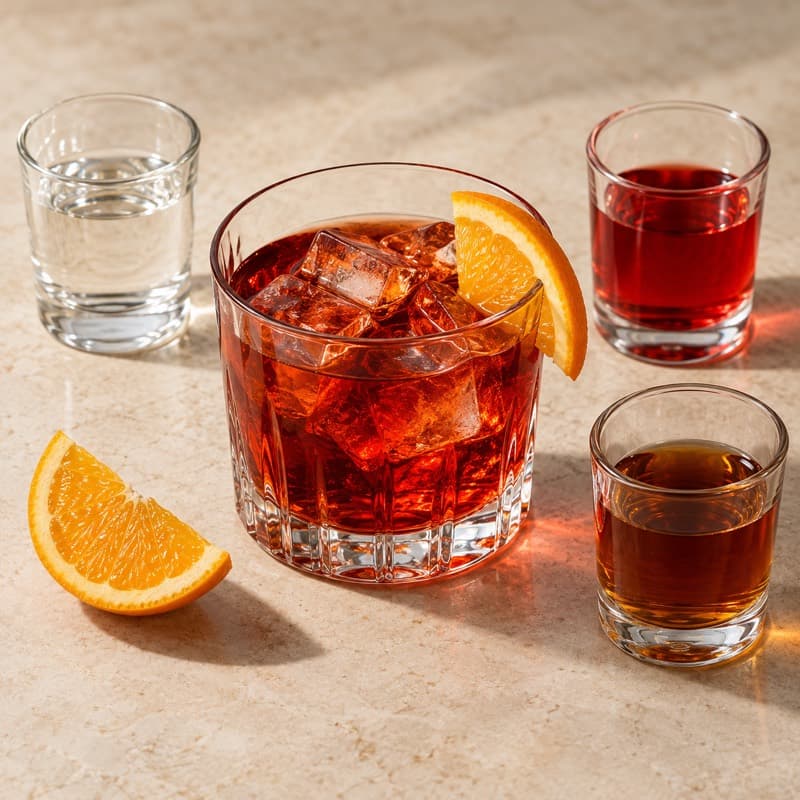
Negroni recipe
1 serving · IBA reference recipeMillilitres control this recipe. US fluid ounces are rounded to the nearest quarter ounce for convenience and are not a different recipe ratio. Dashes, spoons, leaves and other non-liquid measures are listed as written.
| Measure | Ingredient |
|---|---|
| 30 ml≈ 1 US fl oz | gin |
| 30 ml≈ 1 US fl oz | Campari |
| 30 ml≈ 1 US fl oz | sweet red vermouth |
Ice: Fresh cubed ice, fill glass. Garnish: Half orange slice.
Learning bar service? Continue with the Negroni in module 2 of the free course →
How to make it
- Chill the glass and fill with fresh ice.
- Measure all three ingredients directly into it.
- Stir gently to combine and chill; avoid aeration.
- Add the half orange slice.
Why it works: Stirring combines clear ingredients while keeping a smooth texture; the equal-parts formula is memorable.
Common mistakes, useful fixes
Too wine-heavy
check all three measures.
Stale herbal aroma
check the vermouth.
Guest surprised by bitterness
describe it before serving.
Serving the guest
What to tell the guest
It is an equal-parts bitter aperitif with gin, rather than a sweet orange cocktail.
Dietary and product checks
Vermouth may contain sulphites. Check all labels and garnish handling.
Variations
- Boulevardier uses whiskey, with its own reference ratio.
- A sparkling-wine substitution creates a Sbagliato-style variation.
Where does the Negroni come from?
Origin: Florence, Italy; traditionally dated to 1919. (Traditional account repeated by Campari; exact invention scene not proven here)
The familiar Negroni story places Count Camillo Negroni at Florence’s Caffè Casoni in 1919, asking bartender Fosco Scarselli for gin in place of the soda in his usual aperitif. Campari repeats this account; present it as the traditional story rather than an uncontested archival finding. The recipe itself supplies the stronger lesson: three equal measures with different jobs. Gin provides botanical spirit character, Campari contributes bitter orange, and sweet vermouth supplies wine and herbal sweetness. A balanced Negroni still tastes bitter. That bitterness is a feature to describe before recommending it.
Negroni questions
What is the ratio?
1:1:1.
Is bitterness automatically a fault?
No. Assess whether it matches the recipe and the guest’s preference.
From a recipe to a repeatable skill
Learn the method behind the order.
Negroni is a required study in Essential Cocktails & Bar Foundations, module 2: Aperitivo structures. Compare with Americano to understand how replacing soda with gin changes structure.
The course is free. An optional paid certificate tests knowledge in an online exam; it is not an observed practical assessment or an accredited bartending qualification.