The cocktail notebook · Whiskey
Boulevardier
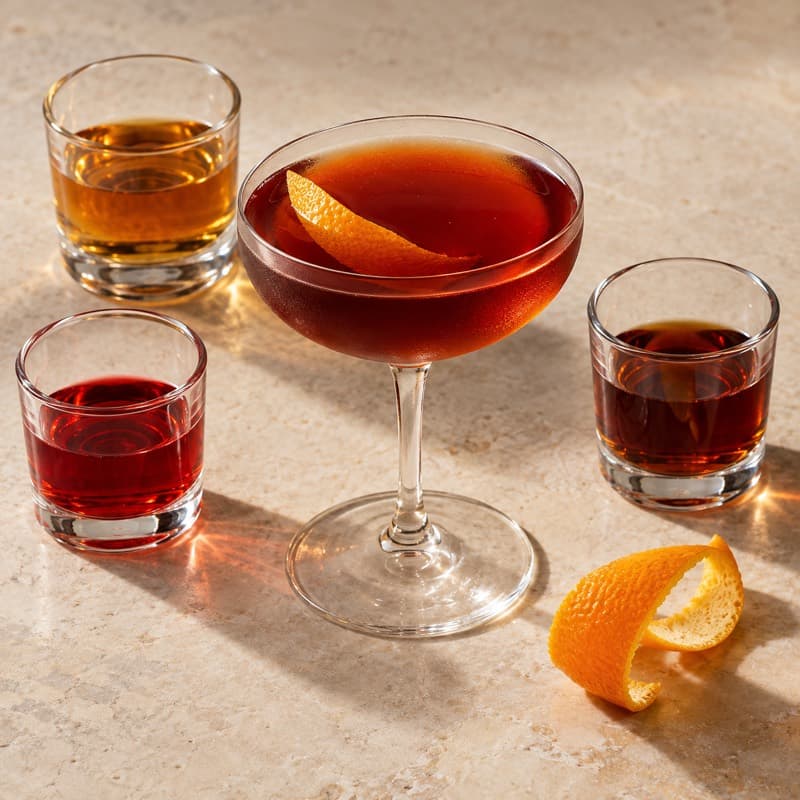
Whiskey warmth, firm bitter orange and herbal wine. A whiskey bitter aperitif made by stir and strain.
- Base
- bourbon or rye whiskey
- Method
- Stir & Strain
- Glass
- Chilled coupe / cocktail glass
- Yield
- One drink
Recipe reference: IBA reference recipe.
Boulevardier recipe
1 serving · IBA reference recipeMillilitres control this recipe. US fluid ounces are rounded to the nearest quarter ounce for convenience and are not a different recipe ratio. Dashes, spoons, leaves and other non-liquid measures are listed as written.
| Measure | Ingredient |
|---|---|
| 45 ml≈ 1.5 US fl oz | bourbon or rye whiskey |
| 30 ml≈ 1 US fl oz | Campari |
| 30 ml≈ 1 US fl oz | sweet red vermouth |
Ice: Cubed ice for stirring only. Garnish: Orange zest; lemon zest is an alternative.
Learning bar service? Continue with the Boulevardier in module 1 of the free course →
How to make it
- Chill the glass and measure all three ingredients into a mixing glass.
- Fill with cubed ice and stir smoothly.
- Strain into the chilled serving glass without ice.
- Express orange zest over the surface and add it.
Why it works: The modern reference ratio is 3:2:2, allowing whiskey to lead more than in the historical equal-parts formula.
Common mistakes, useful fixes
Accidental equal-parts service
check which specification the order uses.
Orange pith dominates
use a clean thin peel, not a squeezed wedge.
Vermouth flatness
check freshness before changing whiskey.
Serving the guest
What to tell the guest
It combines whiskey, bitter orange aperitif and sweet vermouth, with whiskey leading this version.
Dietary and product checks
Vermouth may contain sulphites; check all products.
Variations
- Equal parts is a historical variation; label it.
- Rye instead of bourbon changes spice and texture.
Where does the Boulevardier come from?
Origin: Paris, France; printed in Barflies and Cocktails, 1927. (Dated recipe; attribution to Erskine Gwynne in the book)
The Boulevardier appears in the Parisian 1927 book Barflies and Cocktails, associated with Erskine Gwynne and the magazine of that name. The printed equal-parts version differs from today’s IBA reference, which gives whiskey a larger share. That difference is worth teaching rather than hiding: historical and modern reference recipes can both be identifiable while using different ratios. Its name evokes a person about town. In service, describe the whiskey, red bitter aperitif and sweet vermouth, then ask about bitterness preference. Calling it merely a whiskey Negroni leaves out the ratio decision.
Boulevardier questions
Is the IBA recipe equal parts?
No: 45:30:30.
What does a historical difference teach?
A dated recipe is evidence of that version, not proof that every modern recipe must match it.
From a recipe to a repeatable skill
Learn the method behind the order.
Boulevardier is a required study in Advanced Cocktails & Refined Bar Service, module 1: Spirit and vermouth selection. Use the familiar Negroni structure to explain whiskey-led balance.
The course is free. An optional paid certificate tests knowledge in an online exam; it is not an observed practical assessment or an accredited bartending qualification.