
How to welcome a guest when you don't speak their language
A practical method for hospitality workers: how to greet, help, and take care of guests when you don't share a language - without panic or awkwardness.
It happens on every shift in every tourist town: a guest walks in and greets you in rapid German, or Mandarin, or Finnish, and you understand nothing. What separates professionals from beginners isn't knowing seven languages — it's having a method for the moment when language fails. Here it is.
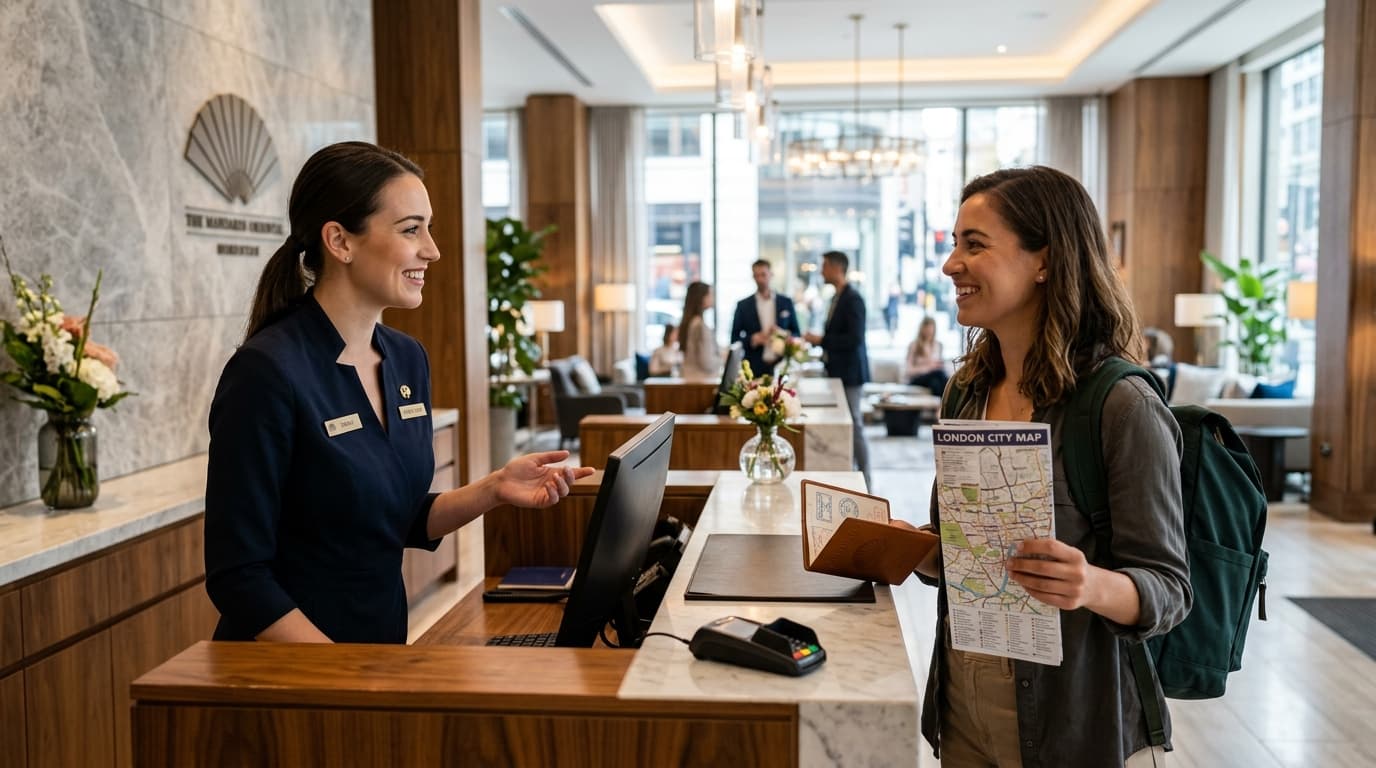
The welcome doesn't need words
The first three seconds of a welcome are non-verbal everywhere on earth: eye contact, a genuine smile, an open posture, and full attention. A guest who feels seen forgives almost any language gap. A guest who feels ignored forgives nothing, in any language.
So before any words: stop what you're doing, face them, smile. You've already done the most important part of the welcome.
Slow, simple English is the bridge
English is hospitality's lingua franca — but only a specific kind of English works. Speak slowly, use short sentences, drop idioms entirely, and pair every sentence with a gesture. 'Follow me, please' with a welcoming hand movement is understood by nearly everyone; 'if you'd be so kind as to accompany me' is understood by almost no one.
If the guest doesn't speak English either, single words plus gestures still carry you far: 'Table?' with two fingers up. 'Drink?' with a pouring motion. Hospitality has a shared physical vocabulary — use it without embarrassment. Every professional does.
Write numbers down, always
Numbers are where language gaps cause real damage: prices, room numbers, times. The rule is simple — never trust spoken numbers across a language barrier. Write them down, type them on a calculator, or show the till display. A price shown on a screen ends every misunderstanding before it starts.
Translation apps: helpful, with manners
Translation apps have quietly become standard hospitality equipment, and guests use them too. The etiquette that keeps them professional: ask with a gesture before pulling out your phone, hold the screen so the guest can read it, and keep sentences short — apps mangle long ones. For anything important (allergies, complaints, payments), confirm the key fact twice in two different ways.
One warning: never use an app to handle an allergy question casually. Confirm the allergen word, show it in the guest's language, get clear confirmation, then tell the kitchen. This is the one conversation where a translation error can put someone in hospital.
Know when to get help
Every team has hidden language assets — the colleague who grew up bilingual, the cook who worked in Berlin. Know who speaks what before you need it, and hand over gracefully when a conversation exceeds you: a smile, a 'one moment please,' and the right colleague beats ten minutes of mutual confusion.
And when the guest leaves: learn 'thank you' and 'goodbye' in the languages you hear most. Ciao, danke, merci, spasibo, xièxie — five words each, and guests light up every time. It says: we noticed who you are. That's hospitality, in any language.
Hospitality English
The English you actually use on shift — free to learn. Access all study modules free, then take the exam to earn your certificate.