Lake Garda summer jobs: how to get hired for the season
Everything you need to know about finding hospitality work at Lake Garda - when the season opens, which towns hire most, what the pay looks like, and how to stand out.
Lake Garda is Italy's largest lake and one of its busiest tourist destinations — roughly 30 million visitor-nights a year, concentrated between April and October. That concentration creates one of the most reliable seasonal job markets in Northern Italy, with hotels, restaurants, beach clubs, ferries, and rental businesses all hiring at scale every spring. If you're looking for your first Italian season, or your most comfortable one, Garda deserves serious consideration.
The geography of hiring
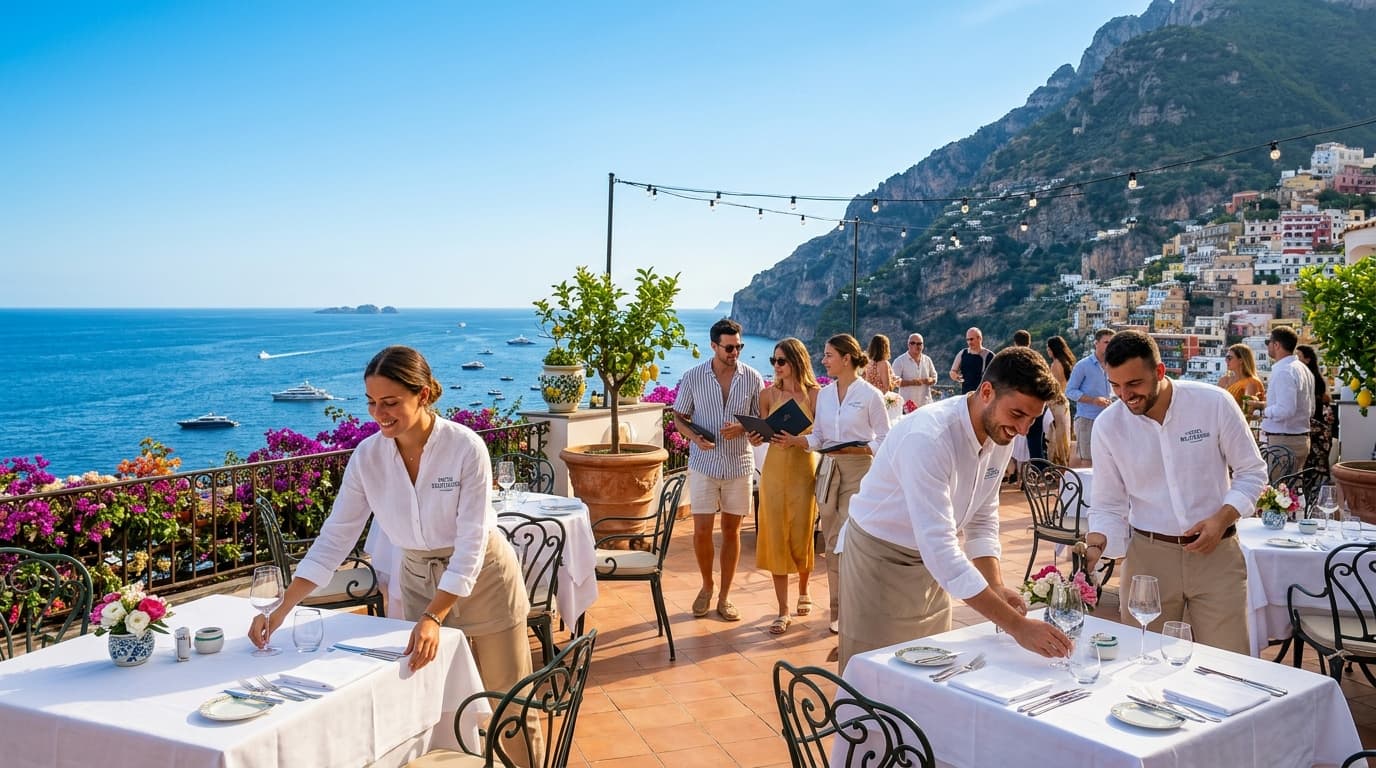
The lake divides into three distinct job markets. The southern shore — Sirmione, Desenzano del Garda, Lazise, Bardolino, Peschiera — is the most accessible, most crowded, and most easily reached from Milan, Verona, and Brescia. Hotels here range from large four-star resort complexes to family agriturismi. Sirmione alone has over 60 hotels on a peninsula barely two kilometres wide.
The western Brescian shore — Salò, Gardone Riviera, Gargnano — is quieter, more upmarket, and home to some of Italy's most prestigious lakefront properties. These places pay better and expect more experience. The eastern Veronese shore — Malcesine, Torri del Benaco, Garda town itself — balances tourist density with a more local feel. Malcesine's cable car to Monte Baldo adds an alpine-tourism layer on top of the lake crowd.
Riva del Garda, at the northern tip in Trentino, is the windsurfing and sailing capital of the lake and operates on a slightly different season — strong in spring and autumn as well as summer, because the wind is better outside peak heat.
Free Course
Hospitality English
The English you actually use on shift — free to learn.
When the season opens and closes
Most properties open for Easter and run through the end of October, with peak hiring in March and April for a May start. By June, the good positions are filled. Contracts are typically four to six months (May–October) under the national CCNL Turismo collective agreement.
September and October are underrated months to target: tourists thin out but serious travellers and conference groups keep hotels busy, temperatures are perfect, and employers are often more desperate than in spring because some early-season staff have already left. Late-season availability is a genuine negotiating advantage.
What jobs are available and what they pay
The full range of hospitality roles exists here: waiters and bar staff (€1,200–1,550 net/month), hotel receptionists (€1,250–1,600), housekeeping (€1,050–1,300), kitchen porters and cooks (€1,150–2,400 depending on level), activity guides and animators at holiday villages (€900–1,200 plus accommodation), and ferry and boat crew for the Navigarda service.
A significant proportion of employers — particularly the larger resort hotels and holiday villages — offer accommodation and meals as part of the package. Read this carefully before comparing salaries: a job that pays €1,100 with full board and lodging is worth more in net terms than €1,450 with nothing included, once you price Garda-area rents.
What employers look for
The guest base at Lake Garda is unusually international: Germans and Austrians make up the largest single group (the lake has been a German tourist fixture since the Romantic era), followed by Dutch, British, Eastern European, and then Italian domestic tourists. The practical consequence is that employers routinely list German alongside English in their requirements, especially on the western and northern shores.
For most front-of-house roles, working English is the minimum expectation — the kind you can use fluently under pressure at a busy breakfast service, not textbook English. Any German is a serious advantage. Italian is usually listed as preferred rather than required for seasonal staff. A demonstrable skills qualification signals commitment in a way that a two-line CV section cannot.
How to apply
Direct applications to individual hotels in February and March get the best results — many Garda properties don't advertise through platforms and rely on word of mouth and email. Target the HR email on the hotel's own website, attach a clean one-page CV with a photo (standard in Italy), and write two sentences explaining your availability window and why you want to work at the lake rather than anywhere else.
Job boards worth monitoring: InfoJobs.it, Indeed.it with 'lago di garda' as location, and the Facebook groups Lavoro Lago di Garda and Stagionali Garda. The tourist boards of Garda Trentino and Garda Lombardia sometimes list opportunities too. Arrive with documentation: if you're an EU citizen, your ID card is sufficient. Non-EU citizens need a work permit arranged before arrival — check the decreto flussi quotas for seasonal workers.
Hospitality English
The English you actually use on shift — free to learn. Access all study modules free, then take the exam to earn your certificate.